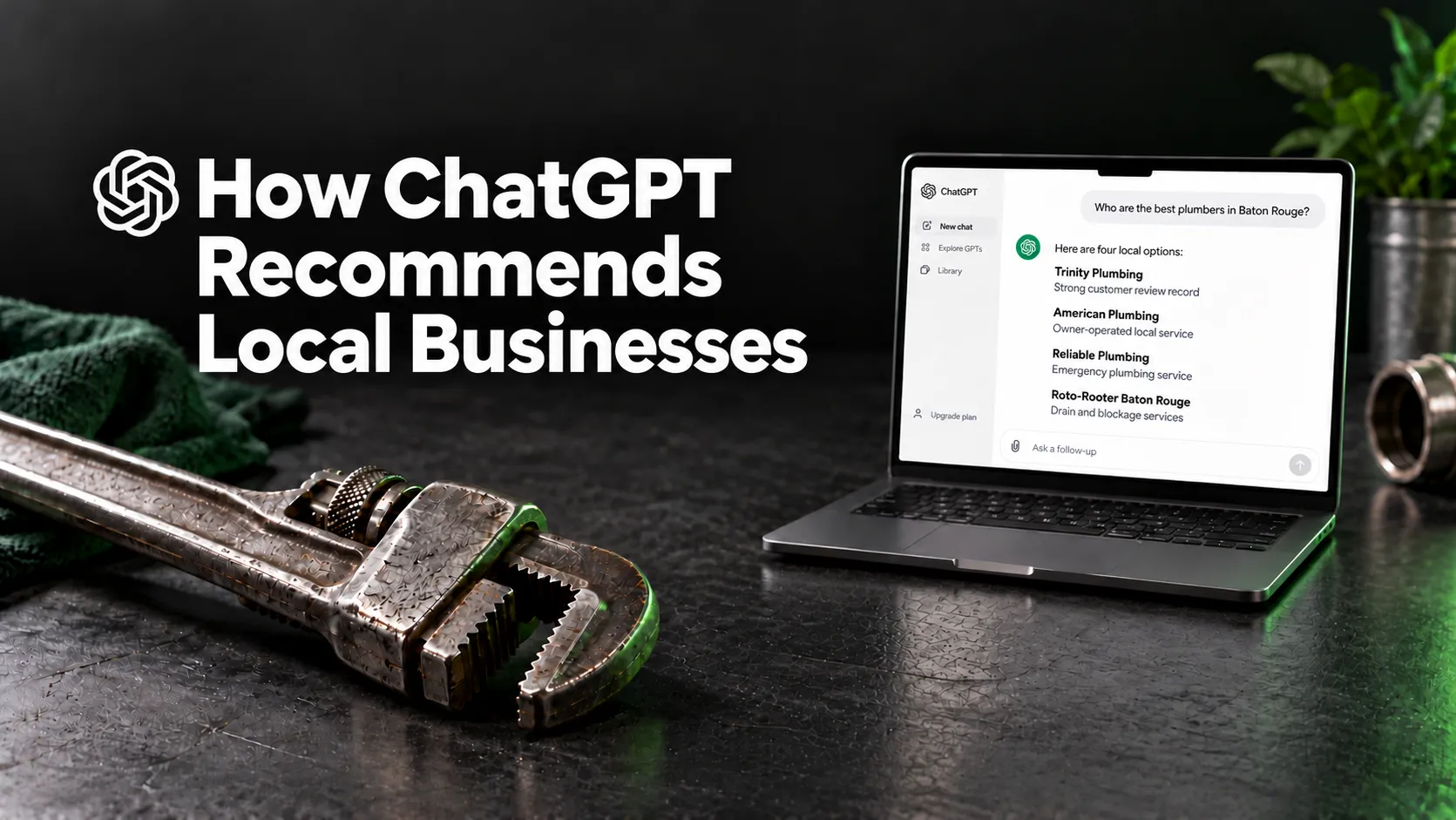
I Asked ChatGPT for a Plumber in My Area. Here’s Who It Picked, ...
I asked ChatGPT for the best plumbers in Baton Rouge. It gave me four names, and a plumber I know do...

Dylan Van Der Westhuizen

Most Google Ads advice is written for businesses in big markets. Read enough of it and you’ll hear the same sequence every time: set up conversion tracking, ramp up conversion volume, then hand the wheel to Google’s smart bidding. In Houston or Atlanta, that works. In Denham Springs, Gonzales, Zachary, or Plaquemine, it usually falls apart.
That matters because most of America is small-town America. According to the U.S. Census Bureau, about 76% of the nation’s roughly 19,500 incorporated places have fewer than 5,000 residents, and only about 4% have 50,000 or more. If you run a local service business, odds are good your market is smaller than the ones most Google Ads advice is written for.
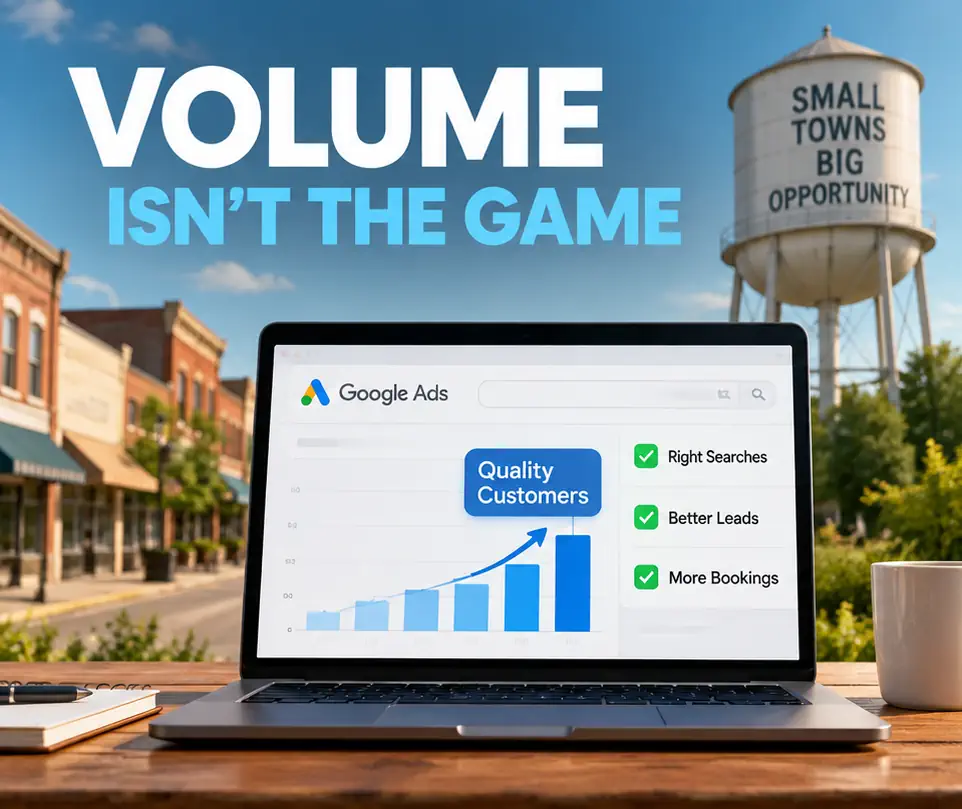
The problem isn’t that Google Ads doesn’t work in small markets. It’s that the standard playbook depends on a resource small markets don’t have: volume. Run the big-city strategy in a small town and you end up paying for clicks that were never going to become customers, while the algorithm never gets enough data to fix it for you.
Here’s how we approach Google Ads for local service businesses in smaller markets, and where it fits inside the Norzer system.
There’s no official population cutoff, and the town’s population isn’t really the point. What matters is the size of the market your ads can actually reach: the people inside your service area who search for what you sell. A plumber in a 10,000 person town that serves three neighboring communities has a bigger market than the town’s population suggests. A business in a larger city that only serves one neighborhood may have a smaller one.
For Google Ads, we define a small market by what it does to your data:
A small market is any service area where your high-intent campaigns can’t realistically produce around 30 conversions a month at the budget you’re willing to spend.
You can check this with simple math: monthly budget ÷ average cost per click × conversion rate. If the answer is well under 30, the standard smart bidding playbook doesn’t fit your account, no matter what the population sign says.
As a rough guide based on the total population of your service area:
| Service area population | What to expect | Default approach |
|---|---|---|
| Under 25,000 | Very limited search volume; a few dozen to a few hundred high-intent searches a month | Position-based bidding, tight keyword set |
| 25,000 to 100,000 | Moderate volume, but rarely enough conversions for smart bidding on a small business budget | Position-based bidding by default; test smart bidding only if conversions consistently approach 30 a month |
| Over 100,000 | Often enough volume for the standard playbook, depending on budget and competition | Build conversion volume, then move to smart bidding |
These bands are a starting point, not a rule. A niche service with few searchers can behave like a small market even in a big city, and a high-budget account can outgrow the small-market approach in a mid-sized one. When in doubt, the budget math wins.
Smart bidding strategies like Maximize Conversions and Target CPA learn from conversion data. The more conversions a campaign records, the better Google gets at predicting which searches and which users are worth bidding on.
Google’s own documentation spells out how much data that takes. Its guidance on the smart bidding learning period says a bid strategy can take up to around 50 conversion events or 3 conversion cycles to calibrate, and that the number of conversions a campaign earns is one of the main factors in how long learning lasts. Google updated that guidance in September 2026, shifting the emphasis from elapsed time to conversion volume. Many practitioners use about 30 conversions per campaign in a 30 day window as the minimum before trusting Target CPA to run on its own.
Now run the math for a small town using real benchmarks. LocalIQ’s 2026 search advertising benchmarks put the average Home & Home Improvement search campaign at an 8.05% conversion rate and an $8.33 cost per click. At those numbers:
| Conversion goal | Clicks needed | Approximate monthly ad spend |
|---|---|---|
| 30 conversions (common practitioner threshold) | about 373 | about $3,100 |
| 50 conversions (Google’s upper calibration benchmark) | about 621 | about $5,200 |
And those clicks have to come from high-intent searches only. In a market of 20,000 to 100,000 people, the total number of people searching “AC repair near me” or “roofer Gonzales” in a month may not produce that many clicks even if you won every single auction. Most small businesses aren’t spending $3,000 to $5,000 a month to begin with.
Starved of data, smart bidding tends to do one of two things. It bids erratically while it stays in a learning phase that never really ends, or it throttles delivery until the campaign barely spends. Either way, you lose.
We’ve taken over small-town accounts that had been running Maximize Conversions for months. The owner assumed Google was “optimizing.” In reality, the campaign never had enough conversions to learn from, and the budget was being spent on whatever the algorithm guessed might work that day.
Keyword Planner is where most small-town advertisers go to check demand, and it often reports single or double digit monthly searches for local terms. Those numbers are averages, and they’re heavily bucketed. An analysis of 60 million keywords by Authoritas found that accounts without an active campaign see only a handful of very broad ranges, such as 10 to 100 or 100 to 1,000. Accounts with active campaigns see around 60 fixed buckets, starting at 0, 10, 20, 30, 40, 50, 70, and 90. At low volumes, the gap between buckets can represent a 22% to 100% change in real demand.
In practice, live campaigns frequently see noticeably more impressions than the planner suggests, so a keyword showing “10 searches” is not necessarily dead. Some of the most productive keywords we’ve run in small markets looked nearly worthless in Keyword Planner. If we had built the campaign around the planner’s numbers alone, we would have cut them before launch.
But don’t overcorrect. Even if real demand is several times the estimate, a small market is still a small market. Treat the planner as directional. Once a campaign is live, your own impression data is the truth.
When volume is thin, the instinct is to widen the net. Broad match keywords get added. Informational searches creep in: “how to get rid of wasps,” “why is my AC leaking water,” “average roof replacement cost.” Spend goes up, clicks go up, and conversions stay flat, because most of those searchers were researching, not hiring.
This is the pattern we see most often when auditing a small-market account. We open the search terms report and find a local plumber paying for “how to unclog a toilet,” “water heater parts,” and “plumbing apprenticeship near me.” None of those people were ever going to book a service call. The advertiser concludes that Google Ads doesn’t work in their town. What actually happened is the targeting got broader than the market could support, and the bid strategy was built for a volume the account was never going to reach.
In a big city, the goal is to feed the algorithm. In a small town, the goal is simpler: when someone searches for exactly what you do, your ad should be at the top of the page almost every time.
If there are only a few hundred high-intent searches in your area each month, each one matters. Showing up for half of them in position three leaves most of your market on the table. Showing up for nearly all of them in position one gives you a real shot at every buyer in town.
High-intent keywords come from people who are ready to hire. For a local service business, that usually means:
Keep these on exact and phrase match. Add informational, retail, and job-seeker terms (“how to,” “DIY,” “Home Depot,” “parts,” “jobs,” “apprentice,” “salary”) as negatives from day one, and review the search terms report every week.
Stacking several tight keyword themes is how you build usable volume in a small market. Loosening match types is how you waste it.
Without enough conversion data, skip Maximize Conversions and Target CPA for now. Use one of these instead:
The right choice depends on budget and competition. The principle doesn’t change: bid for position on high-intent searches, not for an algorithmic outcome the account can’t support yet.
In a small-town campaign, these columns tell you more than CTR or raw impressions ever will. Definitions below follow Google’s documentation on impression share and top and absolute top metrics.
| Metric | What It Tells You | What to Do With It |
|---|---|---|
| Search impression share | Impressions you received divided by the total impressions you were eligible for | Push this as high as budget allows on core keywords |
| Search top impression share | How often you showed among the top ads above the organic results, out of the top impressions you were eligible for | This is where most local ad clicks happen |
| Search absolute top impression share | How often you were the very first ad | Your “position one” rate; aim high on your best keywords |
| Lost impression share (budget vs. rank) | Why you missed auctions | Lost to budget: more spend or fewer keywords. Lost to rank: bids or ad quality need work |
Two notes from Google worth knowing. Impression share only counts the Google Search Network, not Search Partners, and the data can take 24 to 48 hours to update. Google also recommends using top and absolute top impression share, not impression rate, when making bidding decisions, because raising bids can actually lower the rate metrics.
Impression share is one of the first things we check when we take over an account. It’s common to meet an owner who believes their ads show up “every time someone searches,” only to find they’re appearing for well under half of the searches they’re eligible for, and rarely in the first position.
Lost impression share is the diagnostic most people skip. If you’re losing to budget, spreading the same money across more keywords makes it worse. Narrow the keyword set until your core terms reach high impression share, then expand.
Top positions only matter if they produce calls and form submissions. Track phone calls from ads and from the website, form fills, and cost per lead. Listen to the call recordings.
That last step changes decisions more than any dashboard. We’ve listened to “conversions” that turned out to be vendors pitching services, job seekers, and people calling to ask if the business sold a replacement part. On paper, those looked like leads. Recordings show which keywords bring in real customers and which just ring the phone.
Use benchmarks as a gut check, not a target. LocalIQ’s 2026 data puts average cost per lead at $90.92 for Home & Home Improvement, $72.97 for Dentists & Dental Services, $131.63 for Attorneys & Legal Services, and $66.69 across all industries. The same report found cost per lead fell overall for the first time in five years, even as click costs rose.
A campaign with modest traffic that produces steady, qualified calls at a reasonable cost per lead is doing its job, even if it never generates enough volume to “graduate” to smart bidding.
Here’s what this looks like for a hypothetical business: a family-owned plumbing company in Gonzales, Louisiana. Gonzales had about 12,200 residents at the 2020 census and roughly 13,900 by the Census Bureau’s July 2025 estimate, with about 64% of homes owner-occupied. The surrounding service area in Ascension Parish (about 126,500 residents parish-wide at the 2020 census) adds more households, but the plumber only serves part of the parish. More importantly, it passes the budget test below: this is a small market by our definition. The business, keywords, and numbers below are illustrative.
Say the plumber can spend $1,500 a month. Using the 2026 Home & Home Improvement benchmarks from LocalIQ ($8.33 per click, 8.05% conversion rate), that buys roughly 180 clicks and about 14 leads, at a cost per lead near $103. That’s less than half of the 30 conversion threshold, and far from Google’s 50 conversion calibration benchmark. Plumbing clicks often run higher than the category average, which makes the gap wider. Smart bidding has almost nothing to learn from here. Position-based bidding is the right call.
Target Gonzales plus the nearby communities the plumber actually serves, such as Sorrento, St. Amant, Dutchtown, and Prairieville. Under location options, choose Presence (people in or regularly in your targeted locations) instead of the default that also includes people merely showing interest in the area. In a small market, every impression shown to someone in another state is wasted budget.
One Search campaign, three tightly themed ad groups, each pointing to its own service page:
| Ad group | Example keywords | Landing page |
|---|---|---|
| Core and emergency | [plumber gonzales], [plumber near me], “emergency plumber”, “24 hour plumber”, “plumbing company prairieville” | Homepage or emergency plumbing page |
| Water heaters | “water heater repair”, “water heater replacement”, “tankless water heater installation”, “water heater not working” | Water heater service page |
| Drains and leaks | “drain cleaning”, “clogged drain”, “sewer line repair”, “slab leak repair” | Drain and leak repair page |
Slab leak repair earns its own mention in south Louisiana, where many homes sit on slab foundations. It’s a high-value job, and the searches are almost always from someone ready to hire.
Starting negatives: how to, DIY, YouTube, Home Depot, Lowe’s, parts, supply, jobs, apprentice, salary, license, school, course.
Headlines stay within Google’s 30 character limit and lean on local trust signals. For example:
Add call assets so mobile searchers can dial straight from the ad, and location assets tied to the Google Business Profile.
Here’s an illustrative first-month snapshot and what each number would tell us to do:
| Ad group | Search IS | Absolute top IS | Lost IS (budget) | Lost IS (rank) | Action |
|---|---|---|---|---|---|
| Core and emergency | 58% | 34% | 6% | 36% | Losing to rank, not money. Raise the max CPC limit and tighten ad relevance. |
| Water heaters | 31% | 18% | 52% | 17% | Budget spread too thin. Pause the lowest-performing keywords and concentrate spend. |
| Drains and leaks | 72% | 49% | 12% | 16% | Healthy. Keep bids steady and keep mining search terms. |
The fix is never “add more keywords” until the core terms are winning most auctions.
Hard freezes don’t happen often in south Louisiana, but when they do, burst pipe and frozen pipe searches spike and most homes aren’t built for the cold. Build a paused “frozen and burst pipes” ad group ahead of time. When a hard freeze warning goes out, turn it on, raise the daily budget for a few days, and turn it off when temperatures recover. That’s how a small-town plumber captures a surge of high-intent demand without paying for it the rest of the year.
Success here isn’t 30 conversions a month. It’s the plumber appearing first for “plumber near me” and “plumber Gonzales” most of the time, answering the phone, and booking jobs at a cost per lead that makes sense for their average ticket. A single water heater replacement or slab leak repair can go a long way toward covering a month of ad spend.
Some small-market campaigns do eventually build enough data. If a campaign consistently records a healthy monthly conversion count, test Target CPA using your actual historical cost per lead as the target, and watch it closely for the first few weeks. Google notes that conversion data from previous campaigns can shorten the learning period, which is one more reason to track conversions accurately from day one, even while you’re bidding for position.
Consolidating overlapping campaigns into fewer, better-funded ones can also help, since it pools conversion data instead of splitting a thin market into a dozen campaigns that each learn nothing. We’ve audited accounts built with a separate campaign for every nearby town, each running on a few dollars a day. None of them gathered enough data to matter, and together they competed for the same small pool of searches.
If the data never gets there, that’s fine. Owning the top of the page on high-intent searches is a sustainable strategy on its own.
At Norzer, Google Ads is an accelerator, not a foundation. It’s one part of the Norzer Local Digital Domination System, and it only runs once the pieces underneath it are ready.
The website comes first. Every ad click lands on your Entity Home, a fast, managed WordPress site built to convert. In a small market you can’t afford to waste the few clicks you get on a slow page or a confusing layout. Speed alone moves the needle: a Deloitte study commissioned by Google found that a 0.1 second improvement in mobile site speed increased the share of lead generation site visitors who progressed to a form submission by 21.6%. Because we host, secure, and optimize the site ourselves, the landing experience is our responsibility, not a separate vendor’s. When we audit underperforming ad accounts, the problem is often as much the website as the ads: every click sent to a slow homepage, no click-to-call button on mobile, or a contact form that quietly stopped sending emails. The ads were doing their job. The site wasn’t.
Conversion tracking is confirmed before a dollar is spent. Calls and form submissions are tracked and verified before campaigns go live. Without that, there’s no way to tell which keywords produce customers and which just produce clicks.
Ads and the map pack work together. In a small town, the top of Google’s results page is usually a handful of ads followed by the local map pack. Your Google Business Profile, reviews, and local SEO determine whether you show up in the map, and whether people trust you once they find you. BrightLocal’s 2026 Local Consumer Review Survey found that 97% of consumers read reviews for local businesses, 68% require at least a 4-star rating, and 47% won’t use a business with fewer than 20 reviews. An ad in position one can’t overcome a thin or weak review profile. When ads and the map pack are both working, one business can hold the most valuable space on the page for its core searches.
Ads cover the gap while SEO compounds. Local SEO and Google Business Profile work typically show early movement in 60 to 90 days, with stronger market position building over 6 to 12 months. A focused, high-intent campaign produces leads during that ramp, then shifts from carrying the load to reinforcing it.
One team owns the whole path. Website, hosting, tracking, Google Business Profile, and ads all sit with the same accountable team. If leads dip, there’s no back and forth between an ad agency, a web developer, and a hosting company about whose problem it is. It’s ours.
We’ll tell you when ads don’t make sense. That’s usually when:
In those cases, the better investment is almost always the foundation: the website, the Google Business Profile, and reviews. Ads amplify what’s already working. They don’t fix what isn’t.
Small-town Google Ads isn’t a smaller version of big-city Google Ads. It’s a different game. Stop trying to generate the volume the algorithm wants, and focus on showing up first, every time, for the people in your area who are ready to hire.
If you run a service business in a smaller market and your ads haven’t been producing, talk to Norzer. We’ll look at what’s actually happening in your account and tell you plainly whether ads, SEO, or your website is the right place to start.