How to Find the Content Gaps Hiding in Your Google Search Console Data
Your Google Search Console account already knows which searches you are showing up for and losing. A...

Ryan McCain

AI-powered visual website monitoring for small businesses using the Hermes agent framework. Here’s how we built an automated site monitoring system that catches broken layouts, plugin failures, and silent errors before your clients notice.
Most website monitoring is a lie.
You sign up for an uptime service, it pings a port every five minutes, and if the server responds, you get a green checkmark. Site’s up. Everything’s fine. Go back to sleep.
Except the site isn’t fine.
A WordPress plugin auto-updated at 3 AM and shattered the mobile layout. A theme patch pushed a broken CSS rule that turned your hero section into a blank white rectangle. A client’s employee logged in, pasted something into the header, and somehow deleted the CTA button on every service page. A hacker injected a redirect script that only triggers for visitors coming from Google, invisible to the client, invisible to the uptime monitor, but actively bleeding leads every hour it goes undetected.
The server never went down. The port never closed. The uptime monitor never fired.
That’s the gap every small business owner lives in: the space between “the server is alive” and “the website is actually working.” It’s a dangerous gap, because the first person to discover the problem is almost always a potential customer who clicks away and never comes back.
So we built something to close it.
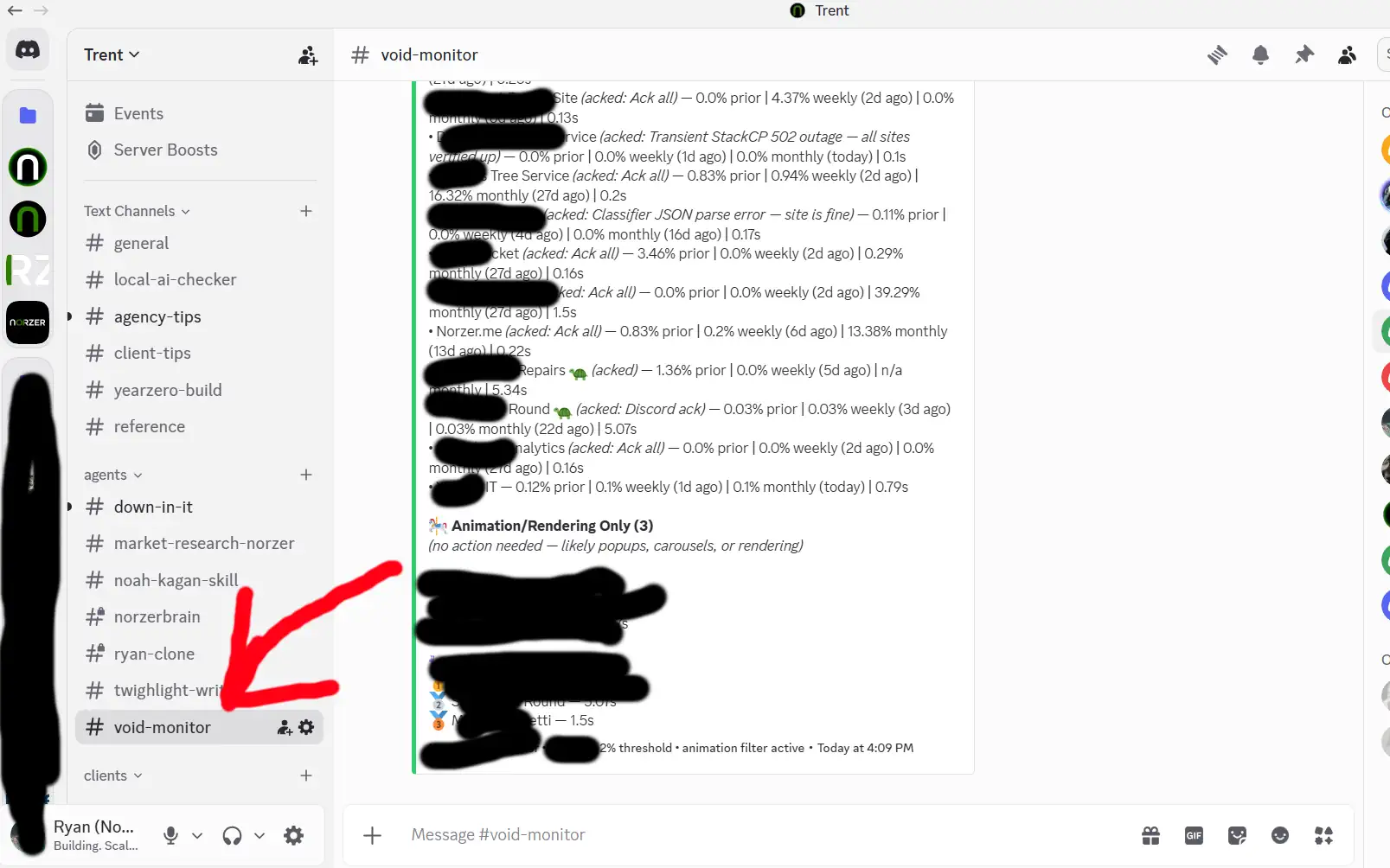
At Norzer, we run an AI agent we call Trent, named after Trent Reznor, because around here we name things after Nine Inch Nails. Trent is a Hermes agent running on our Discord server, which means our entire team can talk to him directly, check his findings, and direct him in real time. He lives on our VPS and has one job: watch our clients’ websites like a hawk. We call this system the Norzer Void Monitor, another Nine Inch Nails nod, because if something falls into the void, we want to know about it before anyone else does.
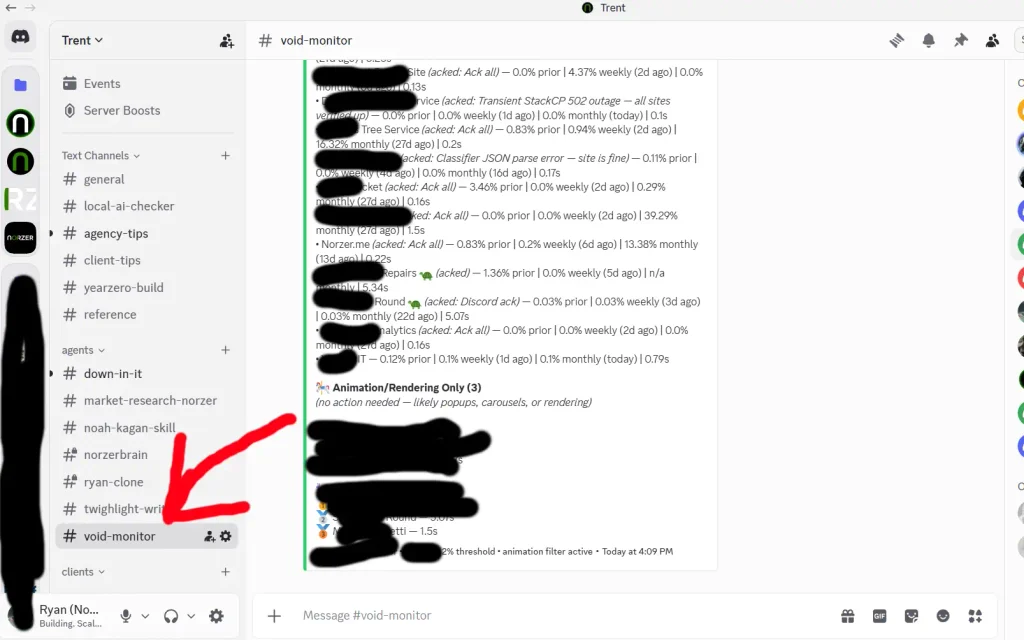
We control everything through Discord, where our team chats with Trent in a dedicated channel to check status, review flagged issues, and trigger manual scans. But because Trent is built on Hermes, that’s just our preferred interface. You can connect to Hermes through Discord, Telegram, Slack, a command-line terminal, or even its API, whatever fits your workflow. The monitoring engine is the same regardless of how you talk to it.
Not by pinging ports. Not by checking HTTP status codes. By actually loading each page and looking at it.
Every hour, Trent visits every key page on every client site. Homepages. Service pages. Landing pages. Contact forms. Booking pages. He loads them in a real browser at desktop and mobile resolutions, waits for everything to render, and takes screenshots. Then he compares what he sees to what he saw yesterday.
Here’s how it actually works.
Every day, Trent captures fresh screenshots of each client page and runs a pixel-level comparison against yesterday’s version. Yes, pixels get compared — that’s how any visual diff works. But the Void Monitor does three things that make it actually useful.
First, it builds a noise map. Over multiple scans, the system learns which pixels change consistently — animated counters, rotating testimonials, seasonal banners, cookie consent popups. These get filtered out automatically so they never trigger false alarms. A carousel advancing to the next slide? The noise map already knows that zone changes every scan and ignores it.
Second, it compares against multiple baselines: the prior day, last week, and last month. Most changes are just daily drift. But a change that holds across three baselines and is still different from last month’s known-good state? That’s worth flagging.
Third, and this is the most important part: when the pixel analysis says something meaningful has changed, Trent doesn’t just fire an alert. He sends both screenshots — the baseline and the current capture — to Gemini Flash, a lightweight vision AI model. Gemini looks at the pages and answers a specific question: is this a real problem or just normal website behavior? BTW, free open source models should work fine if you want to run this locally.
This is where the false alarm problem gets solved. A pixel diff tool sees a gallery image rotated and panics. Gemini sees a gallery image rotated and says “normal rotation, ignore.” A pixel diff tool sees a chat widget opened and triggers. Gemini sees a chat widget and says “minor widget state change, ignore.” A pixel diff tool sees a hero section replaced with a blank white rectangle and Gemini says “major layout failure, ALERT.”
The AI classifier costs about two-tenths of a cent per call — and it’s only triggered when the pixel analysis has already flagged something worth looking at. In practice, that’s a few calls per day across all client sites. The system does the cheap work of counting pixels first, then the smart work of understanding what those pixels mean, only when it matters.
Modern small business websites are complex. Even a simple five-page site pulls from a theme framework, a page builder, a handful of plugins, external fonts, a CDN, and sometimes third-party review widgets or booking embeds. Any one of those dependencies can introduce a silent failure.
Auto-updates make this worse, not better. WordPress plugins push security patches automatically. Themes update. Page builders ship new versions. Each update is a dice roll, 99% of the time it’s fine, and 1% of the time it breaks something subtle that nobody notices for two weeks.
Hosting companies and traditional maintenance plans won’t catch these issues. They check server health. They check for malware. They might even run a broken link checker. But nobody is loading your actual pages at multiple screen sizes and visually confirming everything renders correctly.
Nobody except Trent.
Each client in our care has a defined set of priority pages, the ones that matter most to their business. For most service businesses, that’s the homepage plus their top five service or location pages. For some, it’s the booking flow or the contact form path.
Trent captures each page at three resolutions: wide desktop, tablet, and mobile. The mobile captures are the most valuable because that’s where layout breaks happen most often and where the majority of small business traffic actually lives.
The system flags meaningful changes: missing sections, layout shifts, broken CTAs, formatting regressions, or anything that looks different enough from the baseline to warrant human review. When something triggers, our team sees it within minutes on Discord, not days or weeks later when a client calls wondering why their leads disappeared.
Most weeks, Trent finds nothing. That’s the point. The value isn’t in catching disasters, it’s in the fact that disasters don’t go unnoticed for three weeks while a client’s phone gets quieter and quieter and they can’t figure out why.
We built Trent because the alternative made no sense. A small business paying for a professional website should never be the first person to discover it’s broken. That’s not maintenance. That’s neglect.
If your current provider’s monitoring consists of an uptime check and a prayer that nothing breaks between your monthly check-in calls, you’re paying for hosting, not management. There’s a difference, and it’s measured in how many leads you lose between the moment something breaks and the moment someone finally notices.
Our clients sleep better not because their websites never break, but because when something does go wrong, and something always does, eventually, there’s an AI agent who’s already flagged it, and a team who’s already on it.
That’s what website management looks like in 2026. Not a green checkmark on a dashboard. A robot that actually looks at the site.
—
Norzer helps small businesses generate more leads through our Local Domination System: strategic Local SEO, Google Business Profile optimization, and authority-building campaigns designed to turn your website into a lead engine. The Void Monitor is one piece of that system — making sure the site that’s supposed to be bringing you business is actually working. If you’re ready to stop guessing and start generating real leads, let’s talk.