
I Asked ChatGPT for a Plumber in My Area. Here’s Who It Picked, ...
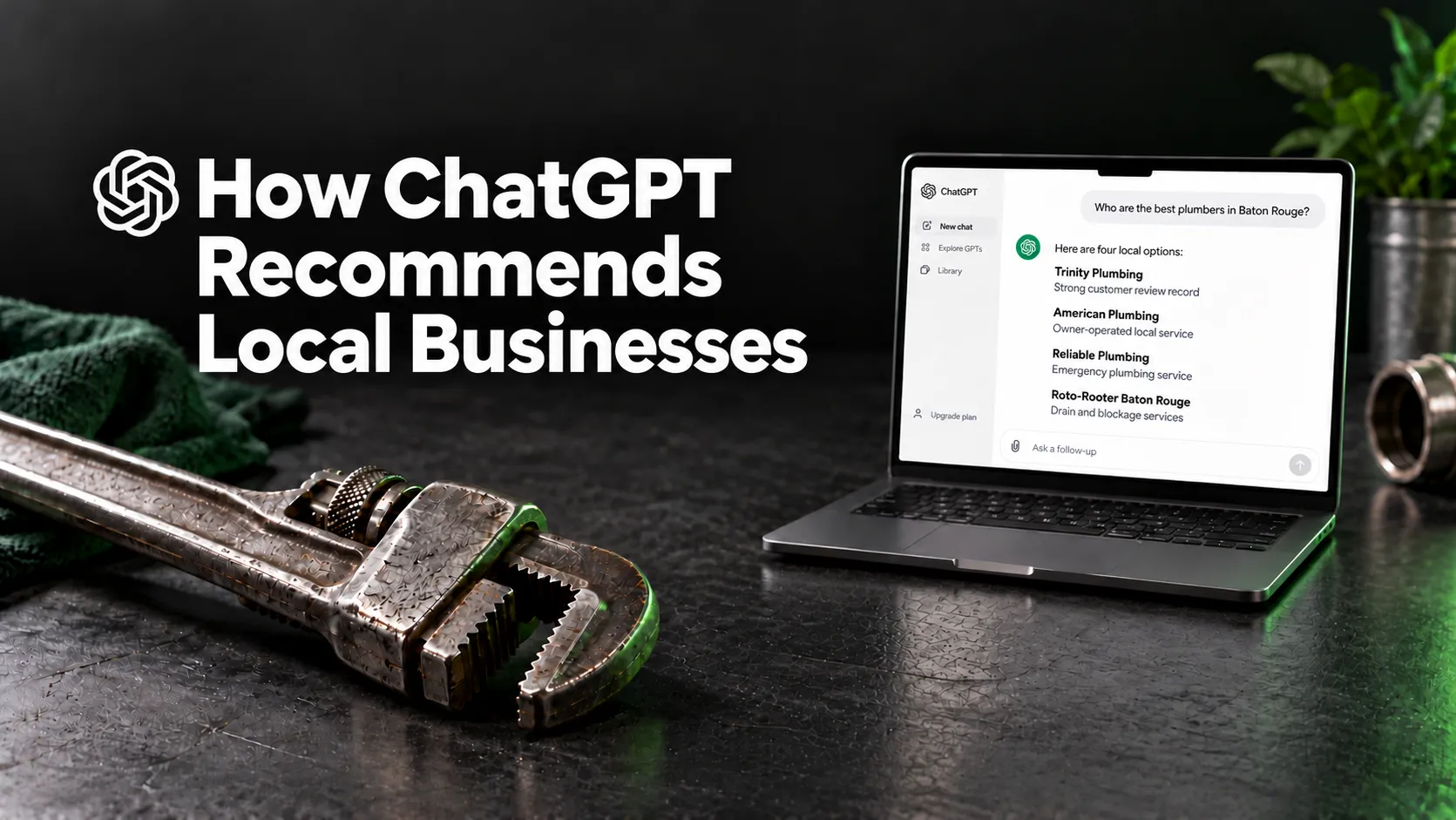
I asked ChatGPT for the best plumbers in Baton Rouge. It gave me four names, and a plumber I know do...

Dylan Van Der Westhuizen

The 72 Google Maps ranking signals that Search Engine Land reported this month point to one lesson for local businesses: Google scores your whole business, not one tab of it. Your reviews, your Google Business Profile, your website, and your local listings all feed the same picture, and here is what holds up, what does not, and what to fix first.
The 72 signals are real in the way that matters. Search Engine Land reported on September 8, 2026 that its author recovered a Google Maps binary exposing a local ranking system called Oyster Rank, which lists 72 signals. The same report is blunt about the limits, and the social posts repeating it tend to leave them out:
The signals the report describes fall into four groups: user engagement (reviews, listing impressions, opens, direction requests, and website clicks), entity traits (chain membership, Wikipedia signals, popularity, and prominence), location data (landmarks and road usage), and web signals such as query volume. The report’s own advice is to move past Business Profile tweaks toward semantic completeness, meaning Google can confidently connect your attributes, concepts, web pages, and review themes to one business.
Other evidence points the same direction. Search Engine Land’s report on the 2024 leak of Google Search API documents found references to a click-based system called Navboost and a module for Chrome data, and noted that those documents did not say how any ranking feature is weighted. Whitespark’s 2026 Local Search Ranking Factors survey, which collected scores from 47 local search experts, found that review signals and behavioral signals gained importance this year. Those are expert opinions, not numbers Google publishes.
The honest takeaway is the same one Norzer teaches: if nobody knows the weights, you work on all of it. That is why Halo One, Norzer’s system, has four pillars that feed each other: Entity Home (your website), Google Business Profile, Niche Authority (directories, chamber, local links), and Digital Presence (social, offline, and ads). Reviews feed all four. Every signal in the posts lives in one of them, and the full system is laid out in the Halo One companion page.
| Signal group discussed online | Where it lives in Halo One | First fix |
|---|---|---|
| Maps data | Google Business Profile | Right primary category, every service listed, real hours, map pin on your front door |
| Your website | Entity Home | A page for every service on the profile, your unique selling proposition on every page, schema markup |
| Knowledge graph | Entity Home plus Niche Authority | Identical name, address, and phone everywhere, with your site linking out to your key profiles |
| What reviewers say | Reviews, which feed all four pillars | The same open review ask for every customer, and replies that name the service and town |
| User behavior on your profile | Google Business Profile plus Digital Presence | Tappable phone number, a directions link in confirmation texts, a tagged website link |
| Brand relationships | Niche Authority plus Digital Presence | BBB, chamber, real local sponsorships, and people searching your name |
Owner replies. The social posts call your replies a ranking signal. Google has not confirmed that, and the Search Engine Land report does not list owner responses among the signals it describes, so treat it as unproven. Replying well is still worth a few minutes. In BrightLocal’s 2026 Local Consumer Review Survey, 89 percent of consumers expect an owner to respond to reviews, and 80 percent are more likely to use a business that replies to all of them.
Norzer’s rule for a reply is one mention of the specific service, one mention of your town, and one true personal detail. For example: “Thank you, Sarah! We loved putting that new roof on for you, and it was great meeting your kids on install day. Proud to help another Tulsa family stay protected through storm season.” Do not paste one template under every review. A template with the nouns swapped reads like a template, to customers and to anyone checking your profile.
These are invented examples, not real reviews. Notice that each one names a different service, a different town, and a different human detail.
Norzer tip: right after each job, write down one small true detail, such as a pet’s name, a landmark, or a joke the customer made. When the review arrives days later, you have something specific to write back instead of a blank box.
Review content. The posts are right that what reviewers say now matters more than the star count. If a tax accountant has 50 reviews that all praise tax prep, AI tools have no reason to name that business for consulting.
The fix is not coaching. Ask every customer, after every job, the same open question: describe what we did for you and how it went. A consulting client who describes the consulting work will write about consulting. What you cannot do is script the wording or demand specific content, ask only the customers you expect to be happy, or offer anything in return. Google’s Maps content policy prohibits all of that, and the FTC’s 2024 final rule bans fake reviews and testimonials at the federal level.
Reverse-engineering your most profitable service is smart, as long as you do it with honest asks and not scripts. Here is the process:
Your Google Business Profile and your website have to say the same thing. Every category and every service on the profile needs a home on the website, and every service on the website belongs on the profile. When the two disagree, Google has less reason to trust either one.
Multiple locations. Do not point every profile at the homepage. Each real location gets its own profile, with its own address, phone number, and hours, and its own page on your site that lists the same services the profile lists. An Austin profile links to the Austin page, and a Houston profile links to the Houston page. The word “real” matters: Google’s Business Profile guidelines say virtual offices are not eligible and PO boxes are not acceptable. Each location page also has to be genuinely different, because Google’s spam policies call out pages targeted at specific cities that funnel visitors to one destination as doorway abuse.
Primary category. The primary category is one of the strongest signals on a Google Business Profile. Choose it by studying the top three map pack businesses for your main service, then add every true secondary category. The free PlePer Local SEO Tools Chrome extension shows the categories a competitor uses right on their Maps listing, with no login.
Here is how that plays out for an HVAC company. If the top three results for your main summer search all share one primary category and yours is different, write that down as a gap. Make the change once, only after you could pass video verification, and then track your calls for at least three months before you touch it again.
Norzer would not flip the primary category with the seasons, though. Editing a category, name, or address on a verified profile can make Google ask you to verify again, and a bad edit can take the profile offline. If you want winter furnace work, give furnace repair its own service listing, its own page, and a post, and leave the primary category alone.
Semantic completeness means every page answers the same four questions a real customer is asking: what is my problem, which of your services fixes it, do you come to my area, and why should I pick you over the other company. Map your customer the way an online store does. Here is an invented example for a plumber in Phoenix: a homeowner with a leaking water heater at 12:30 in the morning.
Then build that into the page: the service and city in the headline and first sentence, each service as its own heading, a price range, localized FAQs, a “Why [Your Company]” section, and a review. Finally, check that your Google Business Profile description and service list say the same things in the same words. Read your competitors’ reviews to hear how real customers describe the problem, and write the way they talk, because AI tools match conversational questions to conversational pages.
The social posts say branded searches are a trust signal. Google has not said how much name searches count toward local rankings, and Norzer will not pretend it has. In Norzer’s experience, businesses with a real offline presence do better online, and every person who searches your name already wants you.
The cheap version is to use your exact business name on every truck, yard sign, and door hanger, tell people to search that name instead of typing a web address, and add a QR code that points to your Google profile or review link. Put yard signs on finished jobs only with the owner’s permission, and pick them up when you said you would.
Offline touchpoints that send people searching for you include:
Each one puts your name in front of the exact local people you want. Use “Search [Your Business Name]” as the call to action, since it sends people straight to your profile and reviews.
For directories, the posts name the Better Business Bureau, Yelp, MapQuest, and your chamber of commerce. Here is Norzer’s order:
Whatever you list, your business name, address, and phone number must match your Google profile character for character.
A second Google profile for the same business. The posts call it a cash cow because different queries pull different radii. A second profile at the same location is a duplicate. Duplicates split your reviews and confuse Google about which listing is real, and a suspension can wipe out every review overnight. The legitimate version is a real second location with its own address, phone number, hours, and website page.
Signs on telephone poles and flag poles. Many cities and counties restrict them under sign ordinances, and “we buy houses” style signs have a reputation problem of their own. Your reputation is the asset this whole system protects. Check your local rules first, and lean on trucks, permitted yard signs, door hangers, and QR codes.
One-shot AI optimization. The posts say to feed the signals and your SOP to an AI and tell it to optimize everything. AI is a good partner for audits, checklists, and first drafts. But if AI can write a page in one take without knowing your business, that page is unlikely to rank. The pages that win carry your local knowledge, your real prices, and your own photos.
Then write down your profile views, calls, direction requests, website clicks, and lead count each month. Early movement often shows up in 60 to 90 days, and real lead flow builds over 6 to 12 months. Those are common patterns, not guarantees.
Norzer is writing all of this up, step by step, in Halo One: The Small Business Playbook for Getting Found and Generating Real Leads from Google and AI Search. Profiles are covered in Chapter 3, reviews in Chapter 4, directories in Chapter 5, and offline and social in Chapter 6. The free companion page is at norzer.me/book. If you would rather have Norzer look at your digital footprint, request a free audit, or ask questions in the Norzer community Discord.
Search Engine Land reported on September 8, 2026 that an author recovered 72 signals from a Google Maps binary, and 25 of them are marked deprecated. Only the names were recovered, not the weights, and the signals are one layer of a larger system. The 2024 leak of Google Search API documents is separate and also did not specify weights. For a local small business, the practical answer is to work on every signal: profile, website, reviews, and listings.
Google has not confirmed that owner replies are a ranking signal. They still matter to customers: BrightLocal’s 2026 survey found 89 percent of consumers expect a response, and 80 percent are more likely to use a business that answers all reviews. Reply within 24 to 48 hours with the service, the town, and one personal detail.
Norzer recommends against it. Editing a primary category on a verified profile can trigger re-verification, and a wrong category can quietly hurt every other local SEO effort. Pick the category the top three map pack businesses use for your main service, and give seasonal services their own service listing and page.
No. Google’s Maps content policy prohibits demanding specific content in a review, offering incentives, and asking only happy customers. Ask every customer the same open question about what you did and how it went, and the service will come up naturally when it was the work you did.
Norzer sees early movement in Google Business Profile views and website traffic in 60 to 90 days, and steady lead flow over 6 to 12 months. Those are common patterns, not guarantees, and every market is different.