
Google Maps Ranking Signals: What to Do Now
The 72 Google Maps ranking signals that Search Engine Land reported this month point to one lesson f...
Ryan McCain

There is no single best local SEO book. There is a best one for how you plan to work, and the honest answer is to pick by what you will actually finish.
If you searched this question, you are probably about to spend real money on local search and you want to understand it before you do. That is the right instinct. The problem is that most “best local SEO book” pages are affiliate lists written by people who did not read the books, and the rest are written by authors ranking themselves first.
Full disclosure before I say another word: I wrote one of the books on this list but I do think my book deserves to be in any book list related to local SEO. I put it last on the list, I tell you exactly what it does not do, and I tell you who should buy a different one instead. A list that does not do that is a sales page, not an answer.
I judge these by scope, currency, and fit, because that is what decides whether a book helps you. Not by page count and not by how many stars it has.
General SEO books teach global indexation, site structure, crawl efficiency, and domain authority. All of that matters. None of it is how local works. Local runs on three things: proximity to the searcher, relevance to what was asked, and prominence, which is how well known and how well reviewed you are. You can have a technically perfect website and still be invisible three blocks from your own front door.
That is why the general books treat local search as a footnote. A chapter, a checklist, then back to enterprise concerns. Meanwhile, the things that decide whether a plumber gets the call are all local-specific: your Google Business Profile, whether your name, address, and phone match everywhere they appear, the local backlinks you earn, the schema that tells the algorithms what you are, and how steady your reviews are.
So, read one general book to understand search, and at least one local book to understand your market. The rest of this page is the local half.
Four questions, and they eliminate most of the field.
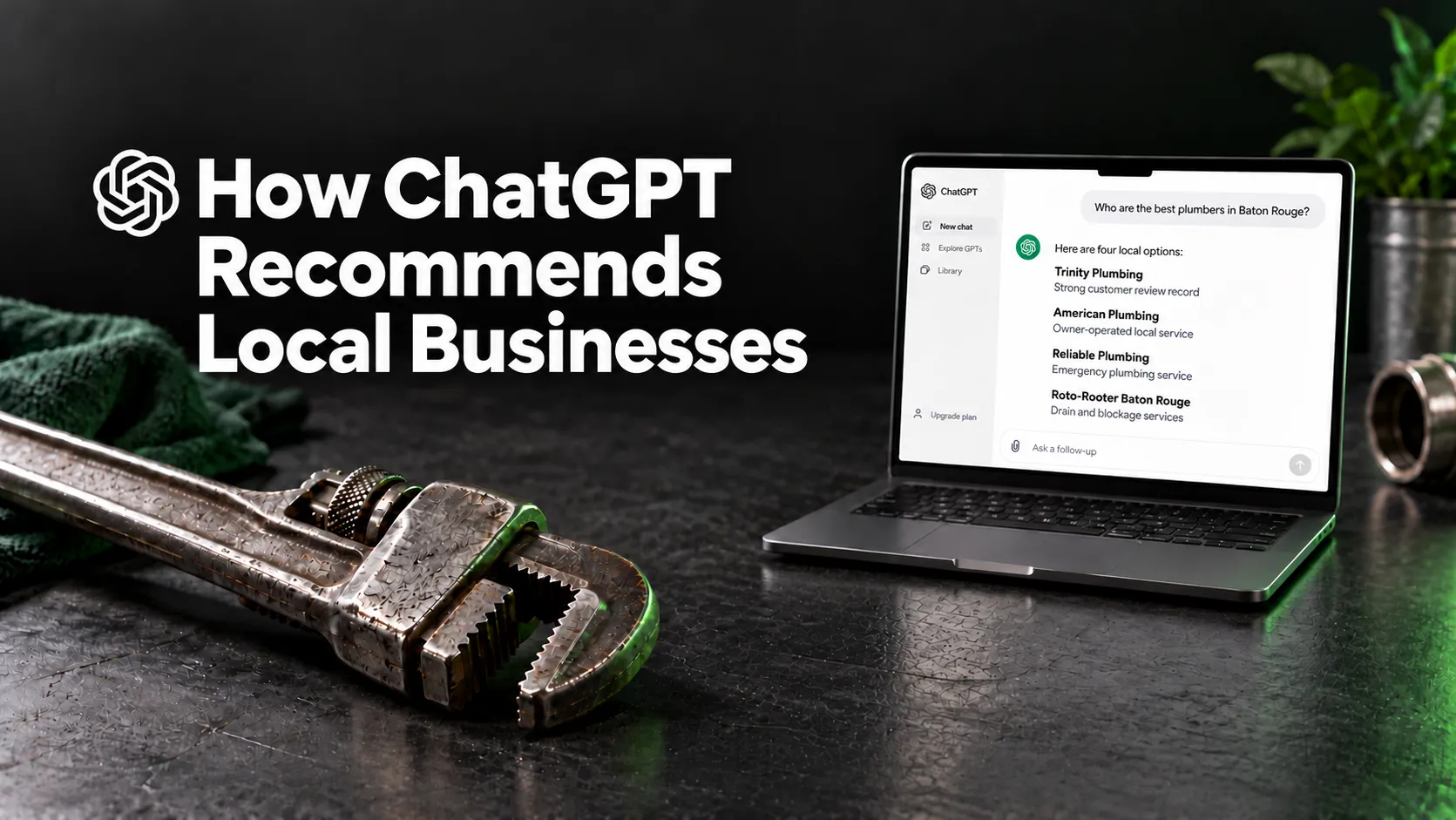
Does it match the search you are actually in? Local search changed more in the last two years than in the previous ten. Your customers now ask ChatGPT and Google’s AI Overviews who to call, not just Google Maps. A book written before AI answers were a real channel is teaching you to optimize for a game that has already moved.
Does it teach a system or a pile of tactics? Tactics age out. A system tells you the order to do things in, which is the part most owners get wrong. Doing the right things in the wrong order wastes a year.
Does it hand you the artifacts or just describe them? Anyone can tell you to write better page copy. A book that gives you the checklist, the worksheet, and the actual prompts is worth ten times a book that tells you the concept.
Does the author do this work for paying clients right now? There is a difference between someone who has read a lot about local search and someone who runs it for a living. Ask which one wrote the book.
The Art of SEO, now in its fourth edition, is by Eric Enge, Stephan Spencer, and Jessie Stricchiola. It is the closest thing this industry has to a reference volume. It covers how search engines crawl, index, and rank, along with technical SEO, on-page work, links, and the strategy underneath all of it, at a depth few other titles even attempt.
If you want to genuinely understand search rather than follow a checklist, this is the book. It is the one people keep on the shelf and reach for years later, and it is the right pick for anyone technical who wants the mental model more than the tips. Read it and you will stop falling for bad advice, because you will be able to see why the advice is bad.
Two caveats. It is general SEO, not local SEO, so the map pack, Google Business Profile, and citation work that decides whether a plumber shows up in a nearby search are not its center. And it is dense. If you run a small service business and want your visibility fixed this month, this is a lot of book to get through before your first useful task.
SEO 2026 by Adam Clarke is the annual edition of a long-running series, and that is the entire point. It refreshes every year, so unlike most SEO books it is not teaching you a search engine that moved two years ago. In a field where a two-year-old book is a history book, that is a real advantage.
It gives an accessible overview of the main areas: how search works, keyword research, on-page optimization, links, tracking, and local search including the role of Google Business Profile. It touches AI Overviews as well, which most older titles do not. If you want one current book that covers the whole field at a readable level, this is the safest default on the list.
The tradeoff is depth. It is breadth-first, so the local search material is a solid introduction rather than a full treatment of the map pack, reviews, citations, and everything else that decides local visibility. It is also a moving target. Next year there is a new edition, and the copy you bought starts aging immediately.
Roger Bryan’s Local SEO Secrets is built around twenty strategies, and the subtitle is not overselling it. Bryan runs an agency, and it reads like a working playbook rather than a theory text. This is one of the few books written for the person who actually has to get a plumber or a dentist into the map pack on a deadline.
Where it earns its place: it stays local the whole way through. Google Business Profile setup, category and attribute choices, cleaning up citations across the aggregators, building a steady flow of reviews, and pairing map pack work with Local Services Ads. If you consult for local businesses, this is closer to the actual job than any general SEO book.
The limits are age and scope. It was written before AI answers became a channel, so some of what was a secret in it is now table stakes, and there is nothing in it about being readable to an AI agent. It is also a book of tactics, so it tells you what to do more than the order to do it in.
Tom Crandall’s Local SEO: A Roadmap To Successful Local Ranking is short and plain-spoken, and it reads like it was written for someone who has never opened a business listing before. The goal in it is simple: get a small local business discovered in its own town.
Where it earns its place: it is approachable. If you are a solo operator and all of this still feels like a foreign language, this is a gentle way in. It stays on local listings instead of trying to teach you enterprise search, and it does not assume you have a marketing background.
The limits: it is thin next to the bigger books, and it was published years ago, so treat the specifics as background rather than instruction. Read it for the concepts, and get your current tactics somewhere that keeps up.
Search Engine Journal’s A Guide to Local SEO is a guide rather than one author’s book, which cuts both ways. It is written by people who work in local search, it gets updated, and it is free. It does not rot the way a printed book does.
Where it earns its place: it covers what a beginner needs in one place. How the algorithms read location signals, citation building, managing more than one location, structured data, and audit checklists for when rankings drop and you need to find out why.
The limits: it is broad rather than deep. It will get you from lost to competent, and it will not take you from competent to expert in a hard market. Free is free though, and as a starting point that is hard to argue with.
This one is by Brandon Leuangpaseuth, and it is a narrow, practical book aimed at exactly one thing: your Google Business Profile. The author came out of local SEO work with law firms, which means he learned this on accounts where a missed call is expensive, and the book is built around that profile-first approach.
If the profile is your real problem, this is a focused, cheap way to fix it. A profile-first book is genuinely more useful than a general SEO book for many small businesses, because the map pack is where the calls actually come from. For a dentist, a salon, or a contractor, the profile is often the highest-return thing they own.
The limit is that it is a single-pillar book. Your website, your citations and directory footprint, and your overall digital presence are not covered, and Google and AI tools judge the whole footprint rather than the profile alone. A well-optimized profile sitting on an out-of-sync website still underperforms. Treat the subtitle’s timeline claim as marketing rather than a promise, because no book can promise a result in a specific number of days in your market.
Win Local Search by Tomasz Dylik is a beginner-oriented Google Business Profile guide in the EasyStart line. It is written for the owner who has never opened the profile editor and needs someone to walk them through it without assuming any background.
It lands in the same category as the Bible above, with an easier on-ramp. Short, direct, do-this-then-that. If you are brand new and you want to stop feeling lost, starting here is not a mistake.
One thing to note before you buy: the title promises ranking number one on Google. No book can honestly promise that, and it is worth remembering as you read any local SEO title, including this one. It is also still a beginner, single-pillar book, so you will outgrow it, which is fine as long as you know that going in.
Jason Hennessey’s Law Firm SEO: Exposing the Google Algorithm to Help You Get More Cases is aimed at one of the hardest local markets there is. Legal search, and personal injury especially, is where the competition and the money are both enormous, and where the standard tactics stop working.
Where it earns its place: the hard parts transfer to any crowded local trade. Hennessey goes deep on earning real local authority, which means links and mentions from local press, community work, digital PR, and tying high-authority directory profiles back to the business so the profile and the website reinforce each other. If you compete in a market where every rival has a budget, this is the closest thing to a blueprint.
The limits: it is a law firm book. The examples, the directory lists, and the budget assumptions are all legal. Read it for the approach and translate it to your trade. It also assumes you are past the basics, so start somewhere else if you are not.
Mike Martin’s Google Business Profile Management for Agencies: How to Scale Your Agency with the GBP Loop is the only book here written for people who manage listings in bulk rather than one at a time.
Where it earns its place: it covers the parts that break at scale. Standardizing how profiles get set up and verified, turning review requests into a repeatable process instead of a favor you remember to ask for, reporting a client can actually read, and dealing with competitors who stuff keywords into their business name or invent locations that do not exist. Reporting spam is real work and most guides skip it entirely.
The limits: this is not for a single-location owner. If you run one shop, this reads like a manual for a job you do not have.
Dixon Jones wrote Entity SEO: Moving Search from Strings to Things, and it explains why a local business is not just a listing. Google stopped matching strings and started matching entities: a business, an address, a service category, and the relationships between them.
Where it earns its place: this is the why under the what. It is the clearest plain-English explanation of the Knowledge Graph, and of how schema, internal links, and consistent references across the web tie your business to a real entity in Google’s records. If you have ever wondered why the same business gets different answers in different places, this is the book that answers it.
The limits: it is not a local SEO book, and it is not a beginner book. There is no map pack chapter and no review strategy in it. Pair it with a local book instead of reading it alone.
Ross Hudgens wrote Generative Engine Optimization: The Definitive Guide to AI SEO, and it is the first serious book-length treatment of getting cited by ChatGPT, Gemini, Perplexity, and Claude. Hudgens runs Siege Media, so it comes from an agency that does the work.
Where it earns its place: it is the only title here aimed squarely at the shift that is actually happening. AI tools do not only read your profile and your website. They pull from forums, local media, review sites, and mentions, which is why a business can have a perfect profile and still not get recommended. If you want to understand AI visibility, start here.
The limits: it is general AI search rather than local-specific, and this field moves faster than any book can. Read it for the model of how it works, not as a fixed checklist.
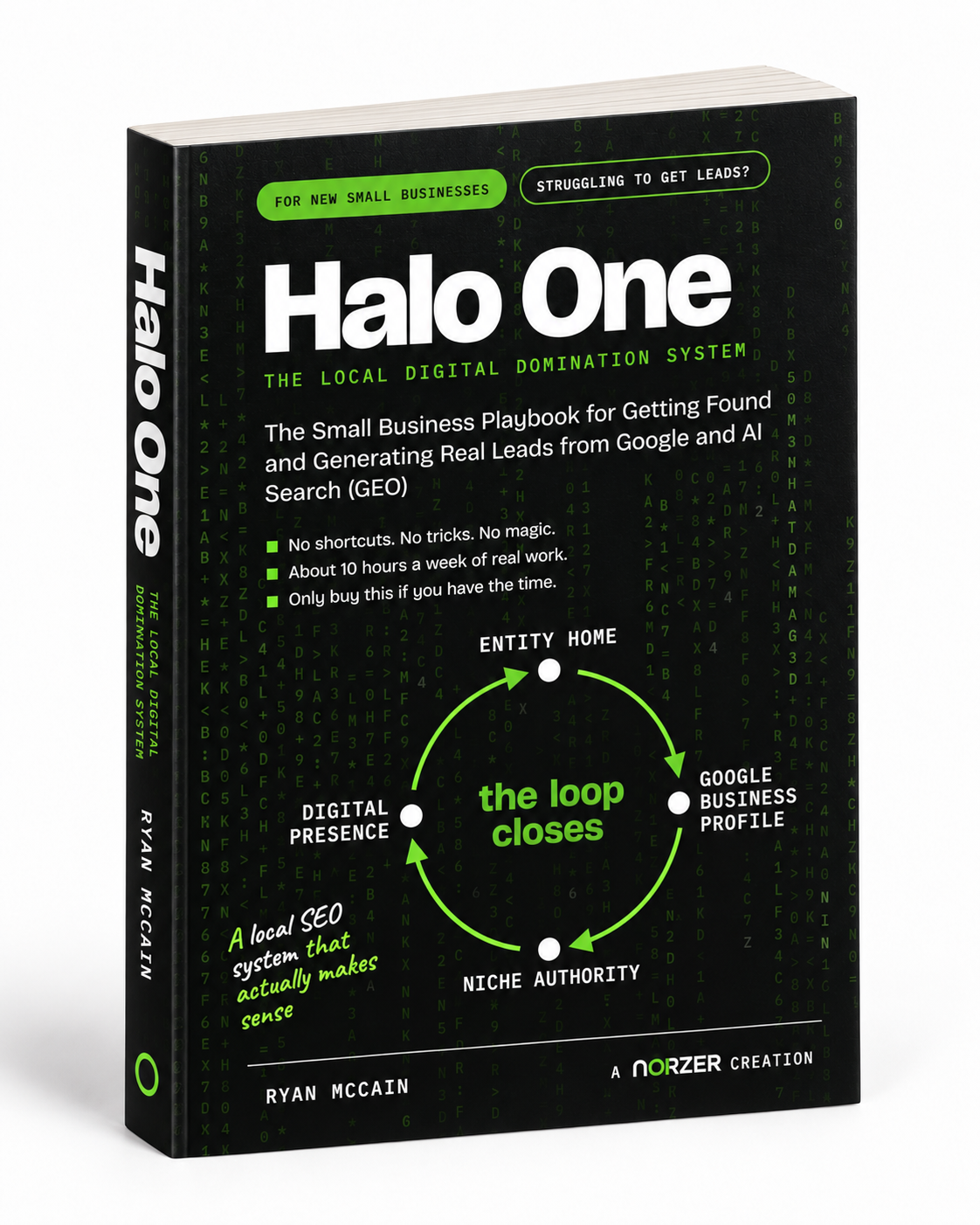
This is the one I wrote, with Dylan Van Der Westhuizen, and I told you I would put it last. It is the system Norzer runs for paying clients, written down in full, in the order we run it. No teaser and no “book a call to hear the rest.”
What makes it different is scope and currency. It covers the whole digital footprint instead of one channel, organized around four pillars: Entity Home, Google Business Profile, Niche Authority, and Digital Presence, with reviews as the proof that feeds all four. It is written for the AI answer era, so ChatGPT, Perplexity, and Google’s AI Overviews are treated as real channels rather than footnotes. It prints every AI prompt we run on real client work, and there is a free companion page with the 30-check audit scorecard, the hours worksheet, the master checklist, and the prompts, whether or not you buy the book. It also labels what is unconfirmed instead of dressing up guesses as settled fact, which most local SEO content will not do.
What it will not do is the work for you, and it is not a weekend read. If you want your profile fixed by Sunday, buy one of the Google Business Profile books above and get moving. If you want to understand the whole job, including the parts you will probably decide to hire for, this is the one.
Two more worth knowing about. The Complete Local SEO Playbook by Mike Martin covers the same ground as the tactics books above, with more weight on link building. Small Business Big Visibility by Jason McKenzie is another owner-focused option. Neither breaks from the pattern of the titles above, so pick them on price and readability.
Reading order matters more than picking one, so here is how I would stack them.
Local SEO is not fast, and no book changes that. The honest timeline is early movement in 60 to 90 days and real local visibility in 6 to 12 months. Those are common patterns, not guarantees. Every market is different, and anyone promising you the first page in a week is selling you a shortcut that will cost you later.
The other thing books cannot fix is execution. Most owners read one, do the first 20 percent, and stall, because the honest version of this job is a lot of consistent work. That is not a knock on you. It is just what the work is.
If that is where you land, read the book anyway. Then go look at what you are not doing.
The companion page for Halo One is free whether or not you buy the book: the 30-check audit scorecard, the hours worksheet, the master checklist, and the prompts. Start with the scorecard and see where you actually stand.
If you would rather not run it yourself, Norzer runs this system for small businesses, one business per niche per zip code, and the first step is an audit.