
Free AI Prompt: Find Local Content Ideas That Bring In Leads
“Post a blog every week” is some of the most common advice small businesses get, and som...

Ryan McCain

The brands spending $100,000 a day on Facebook and Instagram ads win for one main reason: better creative, not smarter account hacks. The good news for a local business spending $20 to $50 a day is that the most important lessons scale down. The bad news is that most of the advice you see online was built for national ecommerce brands, and copying it blindly will burn your budget.
This guide pulls out what actually works for a local service business, shows why your USP has to be the center of every ad, adds the local techniques the big-budget playbooks never mention, and flags what to ignore. It also explains the part nobody talks about: Facebook ads fail most often because the ad, the website, and the tracking are owned by three different people who never talk to each other.
Paid ads are an accelerator. They make a working system faster, and they make a broken system fail faster. Before any campaign goes live, four things need to be true:
This is where most small businesses get stuck. The ad freelancer blames the website. The web designer blames the hosting. The hosting company says it is not their problem. Nobody owns the result, so nobody fixes it. When one provider owns the site, the hosting, the tracking, and the ads, a broken form gets fixed the same day instead of becoming an argument.
Based on our experience onboarding new clients, the ad itself is rarely the first problem. More often we find a contact form that quietly stopped sending emails, a Pixel installed twice so every lead is counted double, or a phone number on the website that does not match the Google Business Profile. Each one wastes ad spend before a single creative decision is made.
For most local service businesses, a realistic starting budget is $20 to $50 a day, or roughly $600 to $1,500 a month in ad spend. Below that, Meta rarely gathers enough data to learn who your buyers are, and results swing wildly from week to week.
For a reference point, LocaliQ’s 2026 Facebook benchmarks put the average cost per lead for lead campaigns at $27.39 across industries, $42.95 for home and home improvement, and $61.56 for dentists. At $30 a day, a contractor near that average would see roughly 20 leads a month before any optimization. That math is why the USP and creative work below matters so much: better ads are the fastest way to beat the average.
Plan on the first 30 days being a testing period. You are paying to learn which USP and which creative angle bring in booked jobs. Judge the campaign on cost per booked job after that first month, not on the first few days.
If that budget feels like a stretch, it is usually a sign to invest in the foundation first. A fast website, a strong Google Business Profile, and a steady flow of reviews produce leads for free, and they make every future ad dollar work harder.
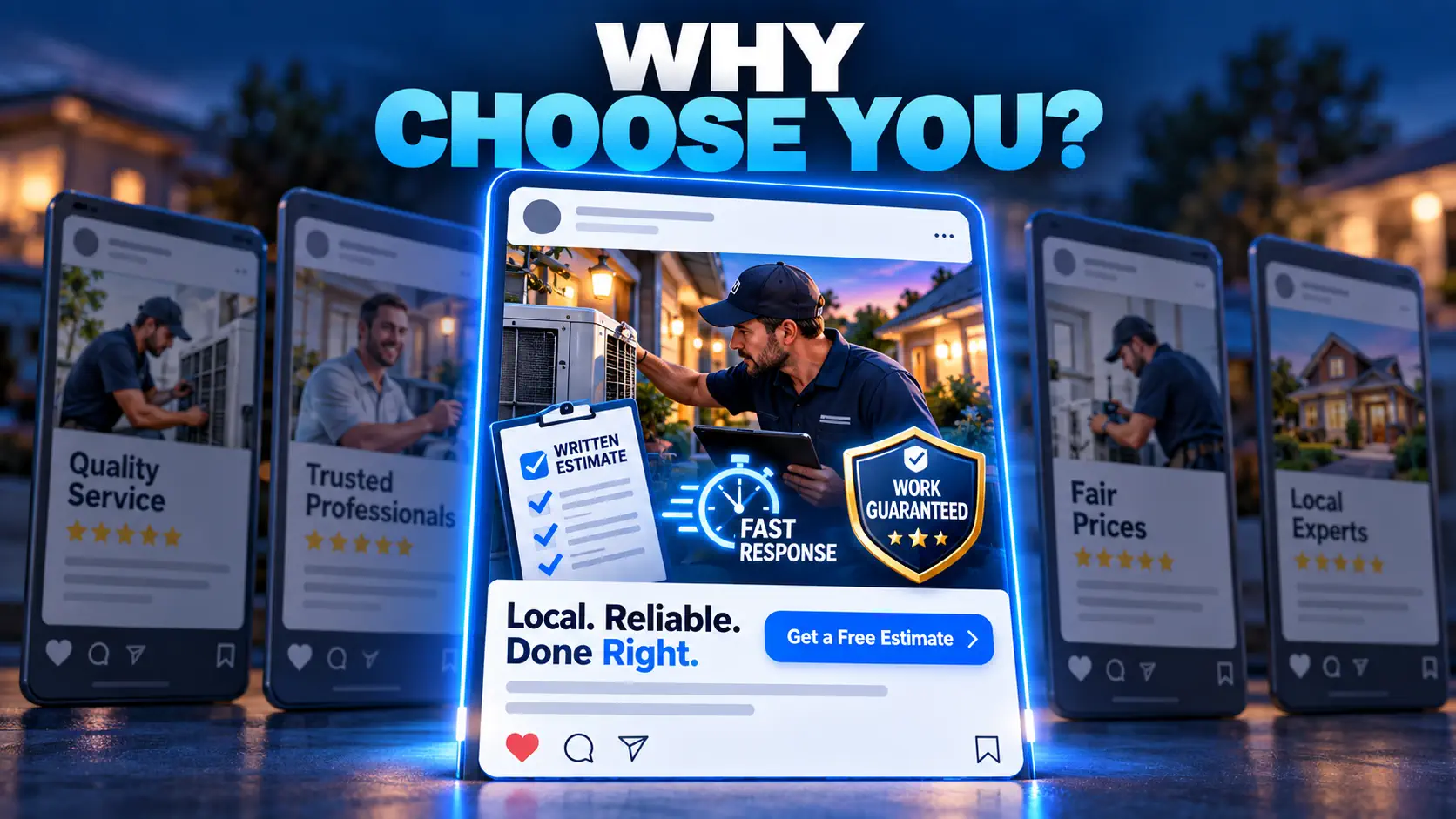
Your unique selling proposition is the single reason a customer should pick you over the three competitors they will also see this week. If your ad could run unchanged with a competitor’s logo on it, it will not win.
Most local ads fail this test. “Quality service, fair prices, call today” describes every roofer, groomer, and law firm in the city. Nobody stops scrolling for it, and nobody remembers it.
Ask yourself three questions:
| Weak (could be anyone) | Strong (only you) |
| Professional mobile dog grooming | We groom in a climate-controlled van in your driveway, so your dog never sits in a kennel |
| Trusted roofing contractor | Written estimate within 24 hours, and the owner inspects every roof himself |
| Experienced injury attorneys | Free case review with an attorney, not an intake assistant, the same day you call |
Put the USP in the first line of the ad copy, in the headline, and in the image or the text on the image. Then repeat it at the top of the landing page. Many people will only see one of those spots, so each one has to carry the reason to choose you on its own.
Based on our experience, the real USP is rarely the one the owner names first. Owners tend to lead with years in business or “quality work.” The stronger hook is usually buried in their reviews: showing up on time, texting photos when the job is done, or explaining the price before starting. When we build ads, we read the reviews before we write a single headline.
The creative is the biggest lever you have. At a small budget, one strong ad will outperform ten average ones spread thin.
The ads that work best in the feed look native. They look like something a real person posted, not a glossy brochure. For a local business, that usually means:
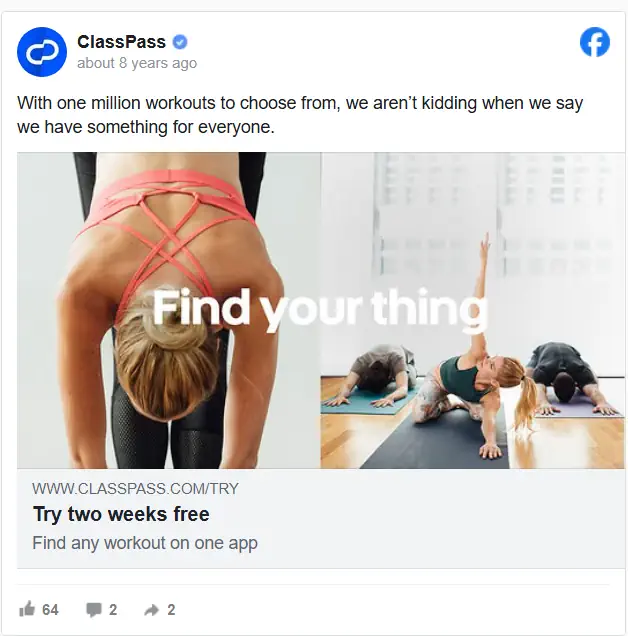
High-spend advertisers use a simple formula: something that stops the scroll, something that creates curiosity, and a big specific benefit. Here is how that translates for a local business:
Short ads look clean, but longer copy often qualifies buyers better. Describe the exact customer, the exact problem, and why your approach is different. The right person reads every word. The wrong person scrolls past, which saves you money.
In our experience with local service businesses, a plain phone photo of the owner or crew on a real job consistently holds its own against polished graphics, and often beats them. People scrolling a local feed respond to faces they might actually meet at their front door.
You may have heard that you need two campaigns: one for testing new ads and one for scaling winners. That structure does not fit a small budget. Meta’s delivery works best when an ad set gets around 50 conversions a week. At $30 a day and a $43 cost per lead, that is about 5 leads a week, so splitting the budget into two campaigns starves both.
For $20 to $50 a day, run one campaign with 2 to 4 ads. Let Meta shift spend toward the ad that performs, pause the clear losers, and add a fresh ad when one fades. The two-campaign split starts to make sense once spend is high enough to feed both.
Start with static images, not video. They are faster and cheaper to make, so you can test more angles. Test different USPs and different problems, not different button colors. A new angle can change your results dramatically. A new shade of blue will not.
Give each ad enough time. At about 5 leads a week, two weeks of results is still noise. Judge lead performance over 3 to 4 weeks, and watch early signals like click-through rate and cost per landing page view in the meantime. Turning ads on and off every few days resets the learning and wastes money.
Your radius should match how far customers will realistically travel, or how far you will drive to them, and that depends on where you are. In a dense city like New York, a 5-mile radius can hold more people than you could ever serve. Around a mid-size metro like Baton Rouge, 15 to 20 miles is common. In rural areas, you may need 30 miles or more just to reach enough people. Whatever the radius, stacking narrow interests on top of it shrinks the audience so much that Meta struggles to find your buyers.
Set your location and a sensible age range, then stop. Let your ad copy and your USP do the filtering. An ad that clearly says who it is for and what makes you different attracts the right people and repels the wrong ones on its own.
One local exception: if you only serve certain zip codes or neighborhoods, target those precisely, unless your ads fall under a Special Ad Category (below). Paying for clicks from people you cannot serve is pure waste.
Meta requires certain businesses to declare their ads under a Special Ad Category: housing, employment, credit and financial services, and social or political issues. The housing category is broader than most owners expect. It covers real estate, mortgages, and homeowners insurance, and it can also cover some home repair and appraisal services (Jon Loomer).
If your ads fall into one of these categories, the targeting rules change:
This makes the USP and creative advice in this guide even more important. When you cannot narrow the audience, your ad copy has to do all the qualifying. Skipping the declaration is not an option either. Meta will reject the ads, and repeated violations can put your ad account at risk.
Meta will happily show your ad everywhere it can. Some of those places bring real customers. Others bring accidental clicks and fake form fills. Cutting the wrong placements saves money, but cutting too many raises your costs, because you force Meta to compete for its most expensive inventory with a small budget.
Keep:
Exclude:
After a few weeks, break your results down by placement and compare cost per qualified lead, not cost per click. If one placement brings leads that never book, turn it off. For some businesses, such as a law firm targeting clients over 45, Facebook alone may end up being the winner. Let your own numbers make that call. Keep in mind, the ad will usually perform better the longer it runs as the Meta algorithm determines what works and what doesn’t work
In our experience, when a local account suddenly fills up with fake names and dead phone numbers, Audience Network is the first place we look. Excluding it from day one prevents most of that cleanup.
When someone clicks your ad, the page they land on should feel like the next sentence of the same conversation. If a Baton Rouge roofer’s ad promises a written estimate within 24 hours of the next storm and the page opens with a generic “Welcome to ABC Roofing,” the visitor feels lost and leaves.
Keep the “scent” consistent:
Sending ad traffic to your homepage is one of the most common and expensive mistakes. Build one focused landing page per ad angle. If you test two different USPs, each one gets its own matching page.
The big-budget playbooks skip these because national brands do not need them. Local businesses do.
Based on our experience, the biggest difference between businesses that get results from Facebook ads and those that give up on them is not the ad. It is what happens in the first hour after a lead arrives. When leads go unanswered until the end of the day, even a strong campaign looks like it failed.
The number that matters is what it costs you to get a paying customer. Likes, reach, and clicks are not revenue.
Track three things:
It also helps to look at total marketing spend against total revenue, not just what Meta reports. Ad platforms tend to take credit for sales that would have happened anyway. If your total revenue is climbing as your spend grows, the system is working, even if one report looks messy.
Some popular advice only works with serious spend. At $20 to $50 a day, skip it:
Yes, when the basics are in place. A fast website, working tracking, and an ad built around a clear USP can bring in steady leads on $20 to $50 a day. Without those basics, even a large budget struggles.
Boosting is the quickest and least complex way to get started. You can pick a post, choose a goal like calls, messages, or leads, and be live in minutes. It is a good way to learn which photos and messages get attention. Once you want to exclude placements like Audience Network, use instant forms with qualifying questions, or track leads accurately, move to Ads Manager.
Lead forms usually bring more leads at a lower cost, but the quality is lower. A landing page brings fewer, stronger leads. If you use lead forms, choose the Higher intent form type and add a qualifying question.
Expect a 30-day testing period. Some businesses get leads in the first week, but it takes a few weeks of data to know which USP and creative bring in booked jobs.
Usually, yes. Facebook and Instagram feeds both work well for local services. Exclude Audience Network and WhatsApp, then let your cost per qualified lead show which placements to keep.
Winning Facebook ads for a local business come down to a short list: a clear USP in every ad, creative that looks real, a simple campaign structure, a landing page that matches the ad, and a fast response when the lead comes in. None of it works without a fast website and tracking you can trust.
That is why Norzer treats ads as one part of a single system. We build the website, host and secure it, set up the tracking, optimize your Google Business Profile, and run the ads, so one team owns the result from click to booked job. If you want help finding your USP and turning it into ads that bring in real leads, talk to Norzer.