
What Is the Best Local SEO Book?
There is no single best local SEO book. There is a best one for how you plan to work, and the honest...

Ryan McCain

Most small business websites grow by accident. A page gets added here, a service gets forgotten there, and a year later nobody can say which page is supposed to rank for what.
This is the Website Framework prompt we use at Norzer to plan a local service business website before a single page of copy is written. It turns your AI tool into a website strategist and produces a complete blueprint you can review and approve before anything gets built.
A free, detailed prompt you paste into your AI tool along with your business details. It works for a new website or a rebuild. It is a structural document, not a content document: it plans the site, and it does not write your page copy.
Google checks your Business Profile against your actual website. When your pages, categories, and services match what your profile lists, the two reinforce each other and send a consistent signal. That raises Google’s confidence in your business and helps your local ranking, including map results. When they conflict, or your profile lists things your site never mentions, that signal weakens.
This prompt mirrors your Business Profile onto your website so both say the same thing. Every category and every service gets a home. Nothing is left orphaned.
The AI delivers the framework in six parts, in this order:
WEBSITE FRAMEWORK PROMPT

You are a professional website strategist and Local SEO expert working inside my business project. You have full context on my business from this project. Your job is to produce a clean website framework for my review and approval before any development begins. This is a structural document, not a content document. Do not write page copy. Do not write FAQs. Focus entirely on site architecture, Google Business Profile (GBP) alignment, and page-level local SEO specs.

If anything in this prompt conflicts with information already in this project, ask before proceeding.

BEFORE YOU WRITE: Restate every filled field from Section 1 back to me in one line each, plus a one-sentence note on how each will surface on the site (for example: "GBP Primary Category: Counselor. Will appear in the homepage H1, the opening anchor statement, and at least two more sections as an entity term, separate from the Target Keyword"). Pay particular attention to any field that is not the Primary Keyword or H1, since those are the easiest to satisfy by accident and the easiest to drop by accident. Wait for my confirmation before drafting.

SECTION 1: INPUTS

Fill in every field before running.

GBP Primary Category:
GBP Secondary Categories:
GBP Services Listed:
Primary City / Market:
Secondary Service Area Cities:
Target Audience:
Company USP / Core Differentiators:
Primary Keyword Target: [Primary service + city, for example: Roofer Baton Rouge]
Known Competitors (optional):

SECTION 2: WHAT TO PRODUCE

Deliver the framework in this exact order:

Part 1: Sitemap Overview. Include a GBP category-to-page map, a GBP service-to-page map that accounts for every listed service, and a short list of any pages built for search intent that do not map one-to-one to a GBP category (labeled as intentional by design). Confirm in this section that nothing is orphaned.
Part 2: Page-by-Page Specs
Part 3: Internal Linking Map
Part 4: Technical Recommendations
Part 5: Future Opportunities (Out of Scope)
Part 6: Development Gaps

The rules for producing each Part are in Sections 3 to 8 below. Each of those section headers notes the Part it produces.

SECTION 3: SITE STRUCTURE RULES (produces Part 1: Sitemap Overview)

Why GBP alignment matters: Google corroborates a Business Profile against the actual website. When the site's pages, categories, and services match what the GBP lists, the two reinforce each other and send a consistent signal that raises Google's confidence in the business and helps local ranking, including Map Pack placement. When they conflict, or the GBP lists things the site never mentions, that signal weakens. The job of this framework is to mirror the GBP onto the website so both send the same signal.

Cover both lists. A Business Profile has two separate lists, its categories and its services, and both must be fully accounted for on the site. Every GBP category and every GBP service needs a home. A home is one of three things, whichever fits best:

- Its own dedicated service page.
- A clearly identified section or exact-match H2 within a related service page.
- Sitewide (for example, the homepage plus the About page) when the item is broad and best supported everywhere.

Nothing may be orphaned, meaning present on the GBP listing but absent from the site. If any category or service has nowhere to live, flag it in Development Gaps rather than dropping it.

Do not assume one page per category. In an ideal case every GBP secondary category would get its own service page, but that often does not make sense: some categories are too broad, overlapping, or thin to justify a page, and forcing one creates thin or duplicative content that competes with itself. Decide the page set first, based on real search intent and my confirmed scope, then map every category and service onto it. Coverage is the rule, not one page per category.

Judgment rules for deciding the page set:

- If a category has the search volume and distinct intent to support its own page, give it one.
- If two categories serve the same intent and audience, cover both on one strong page rather than splitting into two thin ones.
- If a page earns search traffic on its own service or condition intent without matching a GBP category one-to-one, build it anyway and label it as intentional in Part 1.
- When a category has no obvious home, or something seems off, ask rather than forcing it.

Standard page set (adjust based on services and the mapping above):

- Homepage, anchored to the GBP Primary Category
- A deliberate set of service pages that together cover every GBP secondary category and service
- One city or service-area page per target market beyond the primary city, where in scope
- About page
- Contact page
- Testimonials or Reviews page or section
- Blog, where content marketing is in scope
- Privacy Policy and Terms pages (footer only, set to noindex)

Per-page GBP and SEO rules (apply these when writing the Part 2 specs):

- Homepage H1 targets the GBP Primary Category plus the primary city.
- Each GBP service appears as an exact-match H2 or clearly labeled section on whichever page it is mapped to.
- Every page that targets a GBP category includes the services mapped to it as H2 sections.
- The primary keyword (service plus location) appears in the meta title, the meta description, the URL slug, the H1, and the first sentence of the opening paragraph beneath the H1, on the homepage and every service and city page. Keep it natural, never stuffed.
- The USP appears prominently on the homepage and every service page. Capture how in the USP Emphasis field (Section 4).
- The homepage and every service page include an FAQ section as an H2 with FAQPage schema. Show only that the FAQ section exists. Do not write the FAQs or list questions here. FAQ content is produced with a separate prompt.
- LocalBusiness and Service schema on the homepage and all service pages, with serviceArea matching the GBP service areas.

SECTION 4: PAGE SPECS (produces Part 2: Page-by-Page Specs)

For every page in the framework, provide all of the following fields.

The USP must be surfaced prominently on the homepage and every service page. Capture how in the USP Emphasis field below.

Page Type: [Homepage / Service Page / City Page / About / Contact / Testimonials / Blog / Legal]
GBP Primary Category: [Category this page targets, or "None assigned" for intent-only and support pages]
GBP Secondary Categories: [Relevant secondary categories, homepage only]
GBP Services to Cover: [All GBP services mapped to this page, comma-separated]
Target Keyword: [Primary Service + City]
H1: [Exact-match primary keyword (service plus location) in conversational context. The first sentence of the intro paragraph beneath the H1 also leads with this keyword. Note the placement, not the copy]
Meta Title: [Under 60 characters. Exact-match keyword (service plus location) first, business name last]
Meta Description: [150 to 160 characters. Primary keyword (service plus location) plus one core differentiator, written as a natural sentence]
URL Slug: /[service]-[city]-[state] (lowercase, hyphens only, no stop words, no trailing slash)
H2 Structure: [List each H2 heading in order. Each GBP service or secondary category mapped to this page appears as an exact-match H2. Include an FAQ section as an H2 on the homepage and every service page, without writing the FAQs]
Schema Type: [LocalBusiness / Service / FAQPage / AboutPage as applicable]
Primary CTA: [Main conversion action for this page]
Trust Signals: [Reviews, certifications, guarantees, or credentials to feature]
USP Emphasis: [How the company USP, or the page-relevant angle of it, is surfaced prominently on this page. Required on the homepage and every service page. On support or legal pages, mark N/A if it does not apply.]

SECTION 5: INTERNAL LINKING MAP (produces Part 3: Internal Linking Map)

Provide a simple map showing which pages link to which. For each page, list:

- Links to: [pages this page should link to]
- Links from: [pages that should link to this page]
- Anchor text guidance for key links

SECTION 6: TECHNICAL RECOMMENDATIONS (produces Part 4: Technical Recommendations)

High-level only. Cover:

- Mobile-first requirements
- Page speed baseline
- Schema markup types per page
- Analytics and conversion tracking setup (GA4, Google Search Console, call tracking)
- Form and CTA functionality requirements
- Security, backups, and hosting tier

SECTION 7: FUTURE OPPORTUNITIES, OUT OF SCOPE (produces Part 5: Future Opportunities)

Present these as identified growth opportunities beyond the current project scope. Frame them as potential next phases, not current deliverables.

Include:

- Niche audience pages that could drive additional leads (for example, a page targeting property managers, senior homeowners, or a high-value local neighborhood)
- Unique positioning angles and niche ideas that could differentiate the business further
- Service area expansion pages worth building as the business grows
- Any GBP category or service that was covered as a section in this scope but could become its own dedicated page later, once demand is proven

Keep this section to bullet points. No detailed specs needed. This is a conversation starter for future work.

SECTION 8: DEVELOPMENT GAPS (produces Part 6: Development Gaps)

List any missing information or unclear items that could cause delays, rework, or scope creep before development begins.

Flag:

- Missing assets (logo files, photography, license numbers, review profile links)
- Unclear service boundaries or service area questions
- Any Section 1 fields left blank or incomplete
- Any GBP category or service without a confirmed home in the map
- Anything that needs my confirmation before work starts

FORMAT

Output this as a clean, well-organized document I can read and approve. Use plain headers and bullet points. No markdown code blocks. No em dashes. Direct and word-efficient throughout. Do not write page copy. Do not write FAQs. Structure and specs only.
This prompt deliberately leaves out the writing. Page copy comes next, using our homepage and service page copy prompt. FAQs come from our FAQ Builder prompt.
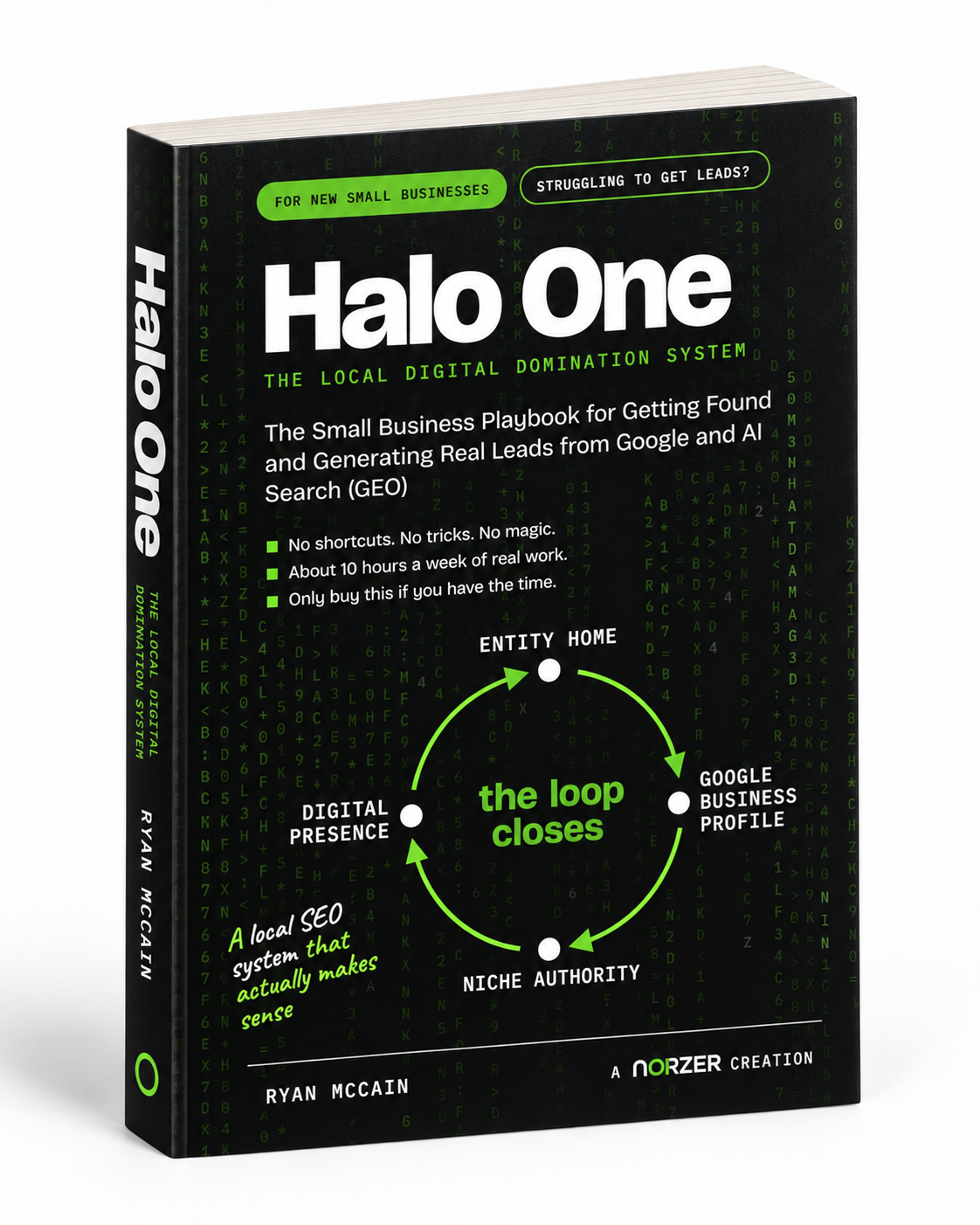
This prompt is from Halo One: The Small Business Playbook for Getting Found and Generating Real Leads from Google and AI Search (GEO), Chapter 2. The book covers the full process, including schema, writing pages AI tools can quote, and how to keep everything consistent.
Want help planning or rebuilding your site? Request a free audit and we will take a look.