What Is the Best Local SEO Book?
There is no single best local SEO book. There is a best one for how you plan to work, and the honest...

Ryan McCain


Most local service pages are written for nobody. They list services, say “quality work at fair prices,” and sound like every other page in town. Google has no reason to rank them, and AI tools have nothing worth quoting.
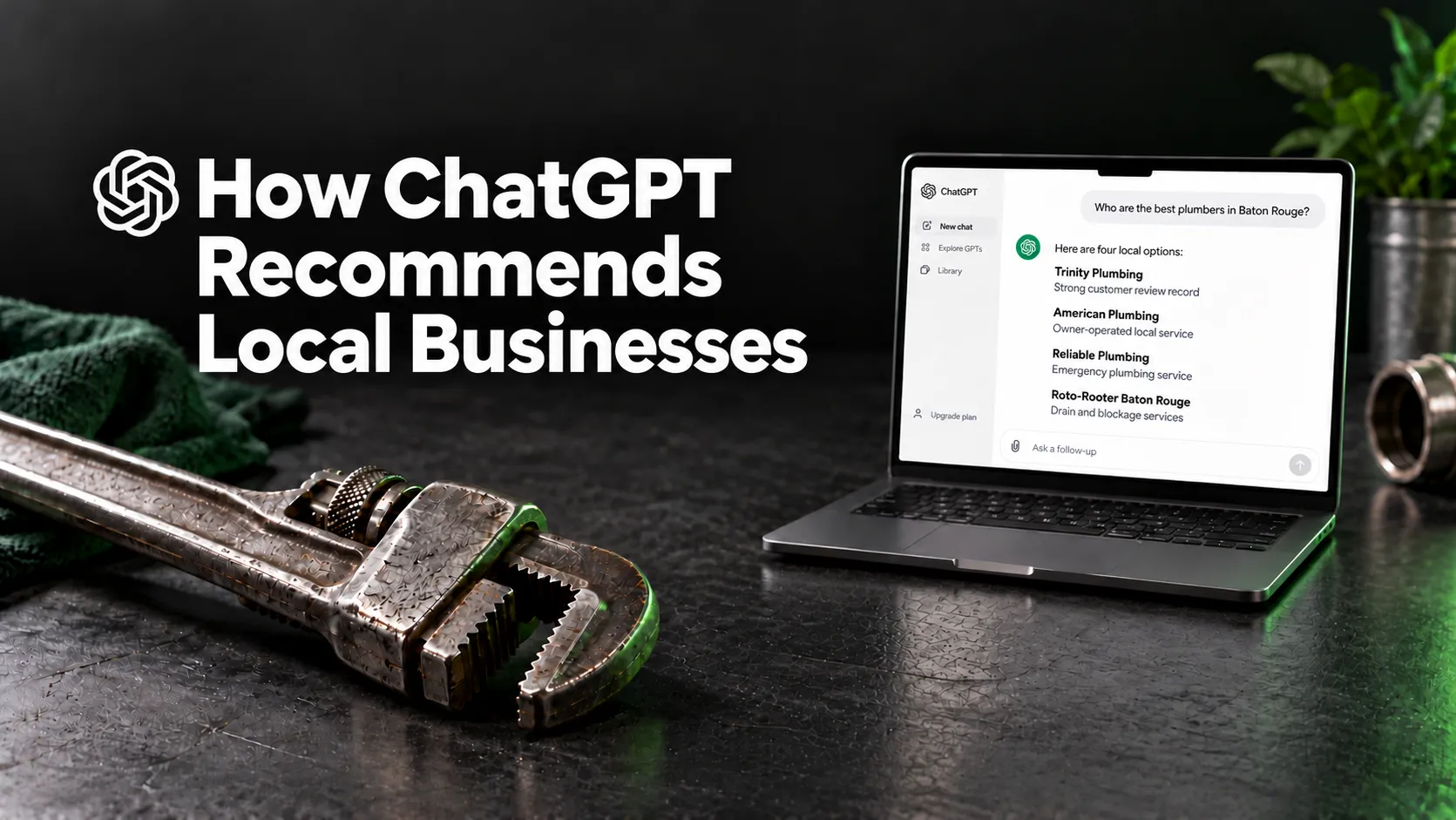
This is the copywriting prompt we use at Norzer to write homepage and service pages for local businesses. It writes for two readers at once: Google, which still rewards clear, keyword-focused pages, and AI tools like ChatGPT and Google’s AI Overviews, which pull single passages from pages and quote them.
A free, detailed prompt that writes the copy for one page at a time, including 8 to 10 local FAQs. It is built to run after our Website Framework prompt, which plans the pages. The framework says what to build. This prompt writes it.
HOMEPAGE AND SERVICE PAGE CONTENT WRITING PROMPT
CONTENT SPECIFICATIONS:
GBP Primary Category: [Enter GBP category]
Target Service Area/Areas/City/Cities: [For a homepage or top-level service page, enter the service areas, for example: Roof Repair Services – San Francisco Bay Area. For a specific city service page, enter the city or neighborhood, for example: Roof Repair Services – San Francisco Mission Bay]
Target Keyword: [Primary service] [City] (for example, “Plumber Houston”)
GBP Target Category: [Enter target category]
Target Audience: Determine this based on what you know about my business and market.
Target length: Look at the top 5 ranking competitors and aim for a bit higher than the average.
Company Name: [Enter business name]
Company USP / Core Differentiators: [List 2 to 4 specific differentiators, for example: “Never use subcontractors,” “Full cleanup included on every job,” “Same-day estimates”]
Top Customer Phrases from Reviews: Pull the top 3 to 5 phrases from the Google reviews of the top ranking competitors.
GBP Secondary Categories: [Secondary category 1] [Secondary category 2] [Secondary category 3] etc.
GBP Services to Mention: [Service 1] [Service 2] [Service 3] etc.
WRITING INSTRUCTIONS:
BEFORE YOU WRITE:
Restate every filled field from Content Specifications back to me in one line each, plus a one-sentence note on how each will surface in the copy (for example: “GBP Primary Category: Counselor. Will appear in the opening anchor statement and at least two more sections as an entity term, separate from the Target Keyword”). Pay particular attention to any field that is not the Target Keyword or H1, since those are the easiest to satisfy by accident and the easiest to drop by accident. Wait for my confirmation before drafting, unless I have indicated urgency.
You are an expert in creating content that competes for the top of traditional Google search rankings AND gets recommended by AI systems like ChatGPT and Google’s AI Overviews.
You understand that Google still rewards comprehensive, keyword-optimized content for map pack rankings, while AI systems look for authentic, conversational content that matches how real people communicate.
AI EXTRACTABILITY RULES:
These five rules are non-negotiable. They exist because AI systems chunk pages into individual passages and sentences. If a sentence cannot stand alone with a clear subject, service, and location, it is invisible to AI retrieval.
Rule 1: The Anchor Statement. The first 40 to 60 words of the page must be a single, self-contained passage that names the business, primary service, city, and core differentiator. No storytelling intro. No warm-up. The anchor statement comes first.
Rule 2: No Orphaned Pronouns. Every paragraph must re-anchor the business name, specific service, or city at least once. Never write consecutive sentences using only “we,” “they,” “it,” “our team,” or “this” without naming the entity. If an AI extracts a single sentence, the reader must know who, what, and where without seeing anything else on the page.
Rule 3: Section Anchor Openers. Each H2 section must open with a one-sentence anchor statement that names the service, the business, and the location before any storytelling or conversational content. The story follows the anchor, never replaces it.
Rule 4: Dense Over Long. Prioritize information density over word count. Every sentence should contain at least one specific claim, entity, location, or verifiable detail. Cut filler ruthlessly.
Rule 5: GBP Category Assignment. Whatever GBP category is assigned to this page, it has to appear at a minimum of 2 times in the page copy, naturally.
AUDIENCE RULE:
Match tone, concerns, vocabulary, and FAQ questions to the target audience defined in Content Specifications. A page for senior homeowners should address trust, safety, fixed-income concerns, and family involvement. A page for property managers should address response time, invoicing, and multi-property scheduling. A page for all local homeowners can use general residential language. The audience shapes the H2 structure, the storytelling, the objections addressed, and the FAQ topics. If the target audience is a niche group, structure H2s around that audience’s specific concerns rather than defaulting to GBP service categories.
USP REPETITION RULE:
The company’s core differentiators listed in Content Specifications are not just for the hero section. Weave each differentiator into at least 3 separate sections throughout the page, phrased naturally each time. Differentiators should appear in the anchor statement, in at least two H2 section bodies, and in the closing CTA section. Each mention should feel like a natural part of the paragraph, not a repeated tagline.
CUSTOMER LANGUAGE RULE:
Mirror the language from real customer reviews naturally throughout the content. The phrases listed in “Top Customer Phrases from Reviews” should appear in the page copy in ways that sound like the business talking the way its customers talk. Do not quote reviews directly. Instead, adopt the same tone, vocabulary, and phrasing customers use when describing their experience.
Your Writing Mission: Write a web page that can compete for the top of Google Maps while also being the type of content AI systems trust and recommend when people ask for local service suggestions.
Content Assignment: Create content for a [Primary Service] company homepage or city service page targeting “[Primary Service] [City]”.
OPTIMIZATION GUIDELINES:
For the Google algorithm:
– IMPORTANT: Include local SEO signals (neighborhood names, local laws and regulations, local terms, local landmarks, service areas, and so on).
– Always include market-specific operational knowledge, preferably specific to this location.
– Use the target keyword in the title, H1, and first paragraph. The USP should be highlighted in the blurb text under the H1 in the hero section.
– Include each GBP secondary category or GBP service as an exact-match H2 heading.
– Use proper heading structure (H1, H2, H3) for content hierarchy.
– Include semantic keywords related to the primary service industry.
For AI systems:
– Sound like genuine recommendations from a trusted local expert.
– Use natural, conversational language that matches how people actually talk.
– Answer real questions people ask, such as “Who’s the best [primary service] near me?” and “What do I do if [common problem]?”, if it makes sense and sounds natural.
– Include authentic local knowledge and community connections.
– Share helpful advice, not just sales pitches.
– Use the exact words customers use when describing their problems.
– This content will go on the company website, so never say things like “visit companysite.com,” since the reader is already on the site.
Balanced Writing Approach:
– After each section’s anchor statement, follow with natural, conversational language that adds local color and storytelling, then include technical keyword optimization.
– Example: “Last winter, half of [local neighborhood] called us when [common problem happened]. Here’s what we learned about emergency [primary service] services in [City]…”
– Follow storytelling with clear service descriptions that include exact keyword matches.
– Balance helpful advice with service-focused content.
CONTENT STRUCTURE:
Output begins with these three lines before the H1:
– Meta Title: [Primary Keyword] | [Business Name]. Under 60 characters, exact-match keyword first, business name last. Include the GBP primary keyword and location.
– Meta Description: 150 to 160 characters. Must include the primary keyword, city, and one core differentiator. Written as a natural sentence that earns the click, not a keyword dump. Include the GBP primary keyword and location.
– URL: /[service]-[city]-[state abbreviation] (for example, /tree-removal-deer-park-tx). Lowercase, hyphens only, no stop words, no trailing slash. Include the GBP primary keyword and location.
Then:
– H1: Exact-match primary keyword in conversational context (include location and GBP primary category).
– H2s: Each GBP secondary category or GBP service as an exact match, but introduced naturally. For niche audience pages, use audience-specific concerns as H2s instead.
– Opening: Anchor statement followed by a relatable local story or common problem.
– Body: Mix of helpful advice and keyword-optimized service descriptions.
– Service Integration: Naturally mention all listed GBP services within relevant sections.
– Local Elements: Specific neighborhoods, seasonal issues, community involvement, and so on.
– FAQ Section: Include 8 to 10 FAQs at the bottom of the page (see FAQ Instructions below).
LANGUAGE GUIDELINES:
– Write at a 5th grade reading level.
– Use short, clear sentences.
– Balance conversational tone with keyword requirements.
– Include both technical terms (for Google) and plain language explanations (for AI).
– Sound helpful and expert, not robotic or overly salesy.
QUALITY SIGNALS FOR BOTH SYSTEMS:
– Demonstrate real local expertise and community knowledge.
– Include specific, helpful information that solves actual problems.
– Reference seasonal or area-specific issues related to the primary service.
– Show genuine business history and community involvement.
– Provide value beyond just listing services.
WORDS TO AVOID: embark, look no further, navigating, picture this, top-notch, unleash, unlock, unveil, we’ve got you covered, transition, transitioning, crucial, delve, daunting, deep dive, dive in, realm, ensure, in conclusion, in summary, optimal, assessing, firstly, strive, striving, furthermore, moreover, comprehensive, we know, we understand, testament, captivating, eager, refreshing, edge of my seat, breath of fresh air, breath of fresh, to consider, it is important to consider, there are a few considerations, it’s essential to, vital, it’s important to note, it should be noted, to sum up, secondly, lastly, in terms of, with regard to, it’s worth mentioning, it’s interesting to note, significantly, notably, essentially, as such, therefore, thus, interestingly, in essence, noteworthy, bear in mind, it’s crucial to note, one might argue, it’s widely acknowledged, predominantly, from this perspective, in this context, this demonstrates, arguably, it’s common knowledge, undoubtedly, this raises the question, in a nutshell, unveiled
FAQ INSTRUCTIONS:
Research Scope:
Analyze customer reviews and discussions from:
– Google, Yelp, BBB (highest priority)
– Angi, Facebook, Reddit, and industry-specific forums (secondary sources)
Goal:
Create localized, non-generic FAQs for the homepage or service page to:
– Improve local SEO and topical authority
– Give Google and AI tools clear, quotable answers to real questions
– Build customer trust and conversions by sounding like a real local pro
FAQ Creation Process:
Question Brainstorm (8 to 10 questions):
Write customer-style questions you would actually hear on the phone, in an email, in reviews, or in Google’s People Also Ask. Use casual, natural language that real customers use (not polished marketing copy). Match the questions to the target audience defined in Content Specifications.
Cover:
– Local slang, nicknames, or jargon when natural (for example: “the Eastside,” “the Heights,” “downtown”)
– Travel or convenience (for example: “How close are you to…?”)
– Neighborhood quirks or zoning rules
– City-specific regulations or permits
– Seasonal or weather factors that affect the service
– Local pricing or timelines
– Audience-specific concerns (for example, for seniors: “Can my adult children call on my behalf?”)
– Anything else that would make the FAQ seem more localized but still seem natural
Answer Writing:
For each question, write a 3 to 5 sentence answer that:
– Restates the concern in plain, everyday language.
– Uses a friendly, expert, no-fluff tone.
– Adds at least one hyper-local detail (landmark, neighborhood, regulation, seasonal factor, pricing norm, local jargon, and so on) when relevant.
– Shows on-the-ground expertise (for example: “We’re right off Main Street by City Hall” or “Most customers from the Eastside take Elm Avenue to avoid traffic”).
– Starts with empathy and ends with reassurance or a clear next step.
– Re-anchors the business name and city at least once per answer (per Rule 2).
– Never includes calls to action in the FAQ answers.
FAQ Format:
Provide FAQs in Q&A format, ready to paste on the page. Do not include explanations or extra notes outside the Q&A pairs. FAQ questions should start with “Q:” and answers with “A:”.
FAQ Quality Bar:
– Sounds like a real local pro, not a corporate template.
– Keywords included naturally, never forced.
– Practical, empathetic, and trust-building.
– Ready to improve local SEO, topical authority, and conversions.
FAQ Do Not:
– Do not use generic, copy-paste style answers.
– Do not skip local context if it would make the answer stronger.
– Do not use em dashes or long dashes in any response.
BEFORE YOU FINALIZE:
Check that every locked field from Content Specifications is literally present somewhere in the draft, not just implied or covered by an adjacent term. This includes GBP Primary Category, GBP Target Category, every GBP Secondary Category, every USP or differentiator, and every GBP service listed. If a field’s exact value or an unmistakable equivalent does not appear anywhere in the copy, list it as a gap rather than omitting it silently. Do not count a related term (like a service name or the Target Keyword) as coverage for a different field (like the primary category).
Success Metric: Content should feel natural enough that AI systems recommend it, while being optimized enough to compete for the top map results. FAQs should sound like a real person answering real phone calls, not a legal department writing disclaimers.
Please reference these notes from my website framework in your copy:
[Paste any notes about this page from your Website Framework here]
Where this comes from
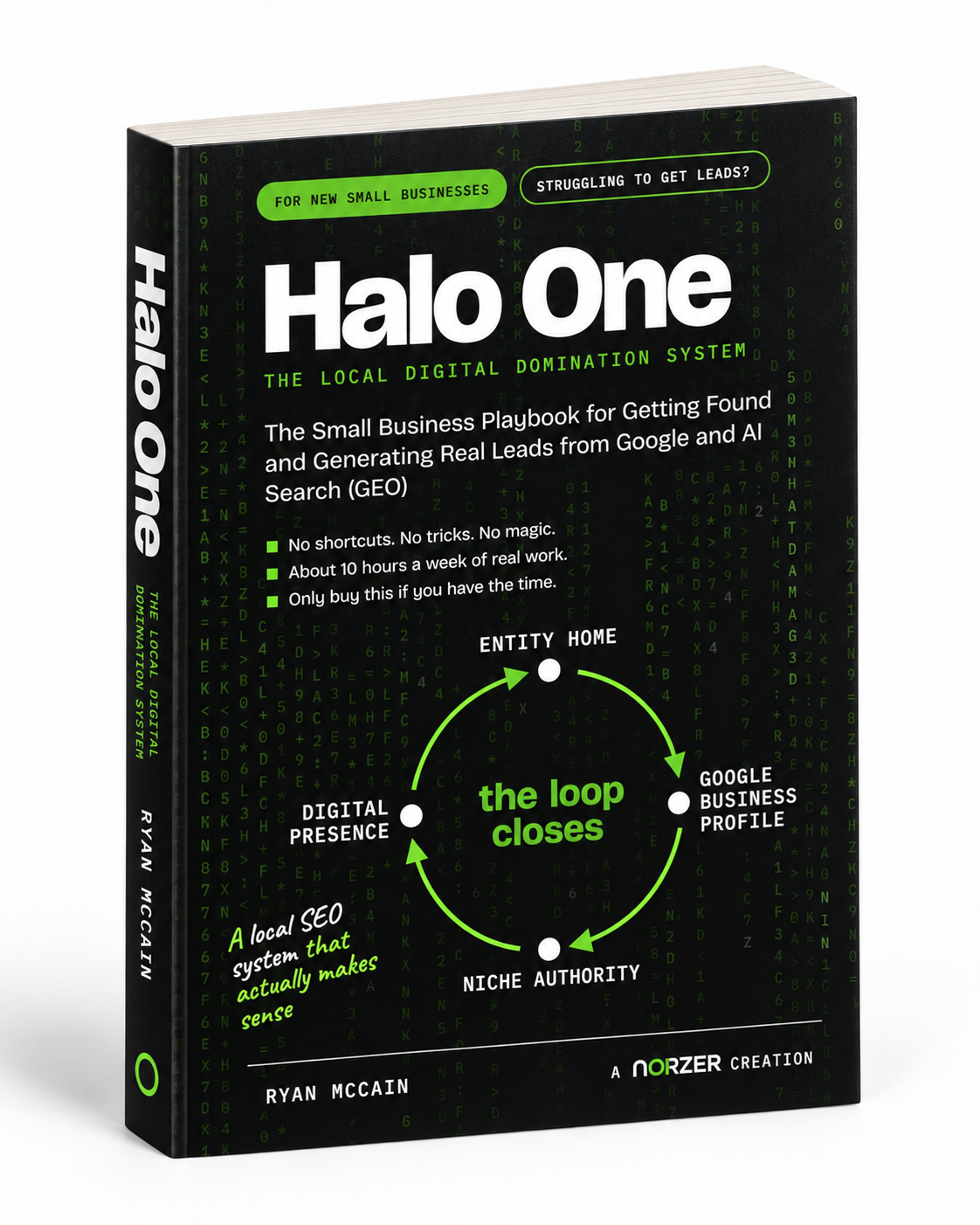
This prompt is from Halo One: The Small Business Playbook for Getting Found and Generating Real Leads from Google and AI Search (GEO), Chapter 2. The book explains the writing rules behind it, how to build city and audience pages that are genuinely different, and how to avoid the thin, copy-and-paste pages Google treats as spam.
Want help writing or rebuilding your pages? Request a free audit and we will take a look.