
AI Website Monitoring: The Whole System We Run on Client Sites With a ...
The full build behind our AI website monitor: Playwright screenshots, pixel diffs, an animation nois...

Ryan McCain

There is no single best SEO agency in Louisiana. There is a best one for a business your size, and size is the thing almost nobody checks.
The short answer: if you own a small business in Louisiana, pick an agency that is built for businesses your size, whose foundation is search rather than general marketing, and that does the local work itself: your Google Business Profile, your reviews, your citations, your service pages, and your visibility in AI answers like ChatGPT. Then make sure one team owns all of it, so nobody can point at somebody else when the phone stops ringing. Reputation matters, but fit matters more. A great agency built for enterprise clients is still the wrong agency for a one location contractor.
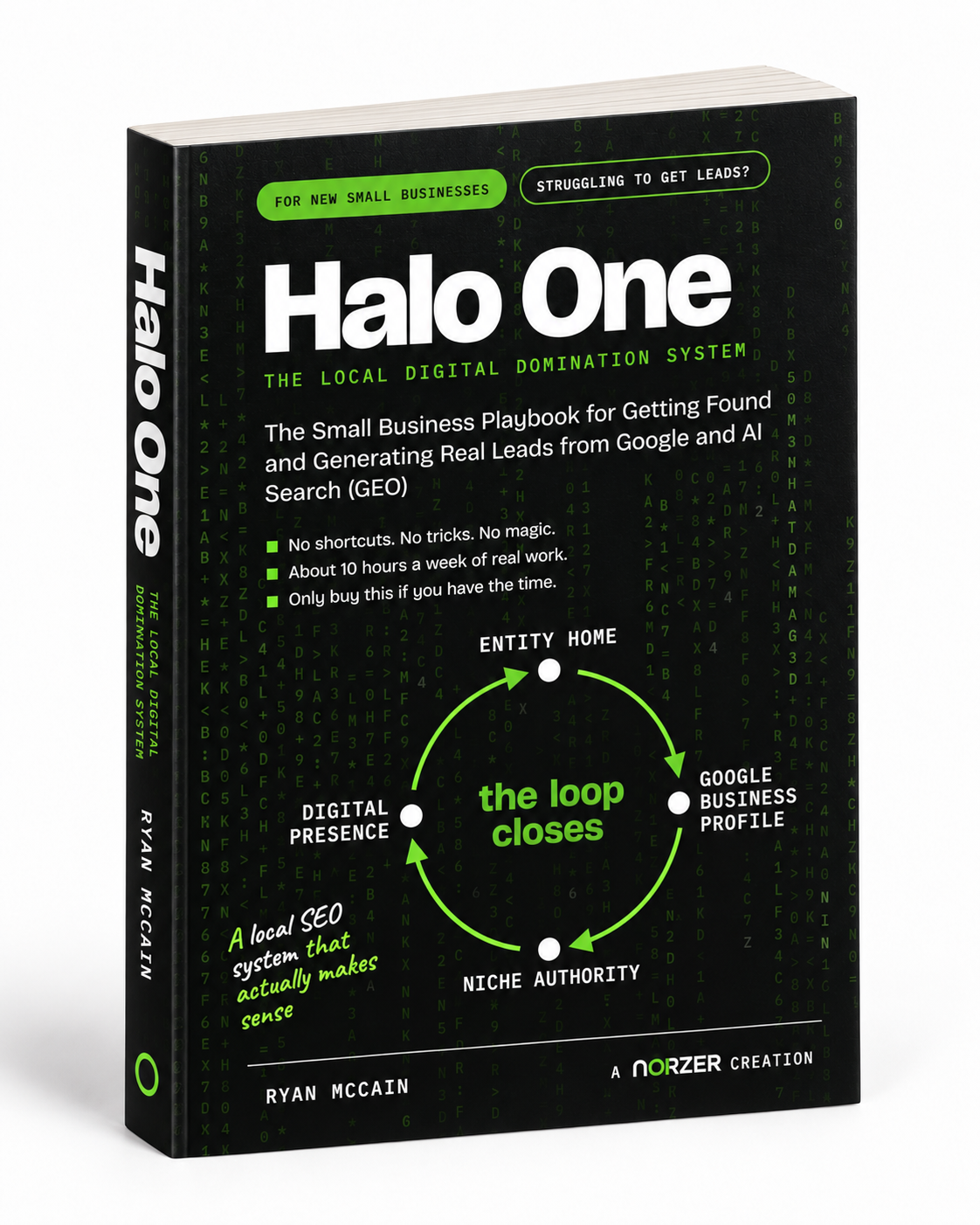
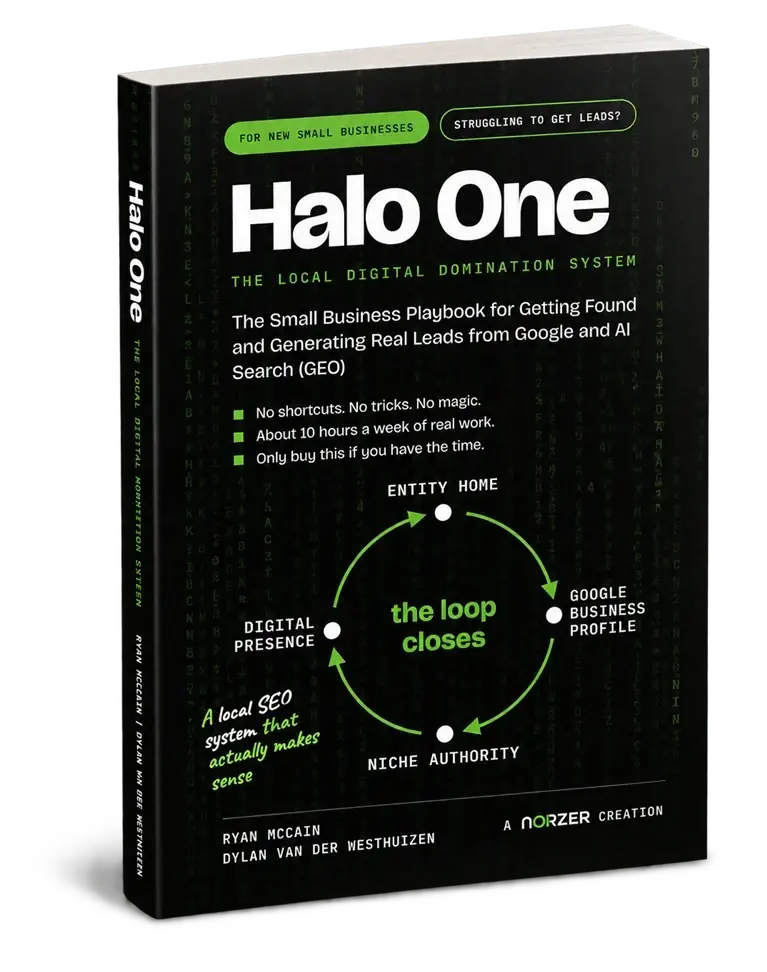
I’m Ryan McCain, and I run Norzer, a local SEO agency in Baton Rouge. So yes, I am one of the agencies you could hire, and you should read this with that in mind. I also co-wrote the book on this, Halo One: The Local Digital Domination System, which lays out the entire system we run for clients, prompts and checklists included. I mention it up front because it is the reason I can write this page straight. Nothing about how we work is a secret, so I can tell you exactly what to look for in anyone you hire, including us.
This page names the Louisiana agencies that actually come up when you search, says who each one fits, and says plainly where we are the wrong call. A page that puts its own name at the top of a list and calls it a review is a sales page, not an answer.
Most owners shop for the best SEO agency in Louisiana. The better question is which agency is best for a business your size, and the gap between those two questions is where the money goes.
Every agency has a cost floor: payroll, office, software, account managers, sales staff, and the owner’s margin. That floor decides what they have to charge, and it decides how much attention is left over for you. A firm that needs five figures a month per client to stay healthy is not being rude when your $600 account sits at the bottom of the pile. Simple arithmetic, and no agency is exempt from it.
That does not make big agencies bad. It makes them a different tool. A firm built for enterprise work is better at enterprise work: multi-location campaigns, big ad budgets, brand guidelines, legal review. If that is your business, hire one of them and be glad they exist.
If you own one location, serve a defined area, and answer the phone yourself, you want the opposite. You want an agency whose whole business is built around owners like you, with pricing, timelines, and a workload that fit one operator.
And you are not the exception. Louisiana has roughly 511,000 small businesses, about 99.5 percent of every firm in the state, according to the SBA Office of Advocacy’s Louisiana profile. You are the market.
Here is the part nobody puts on the proposal. A working online presence for a single-location business is roughly twenty separate jobs:
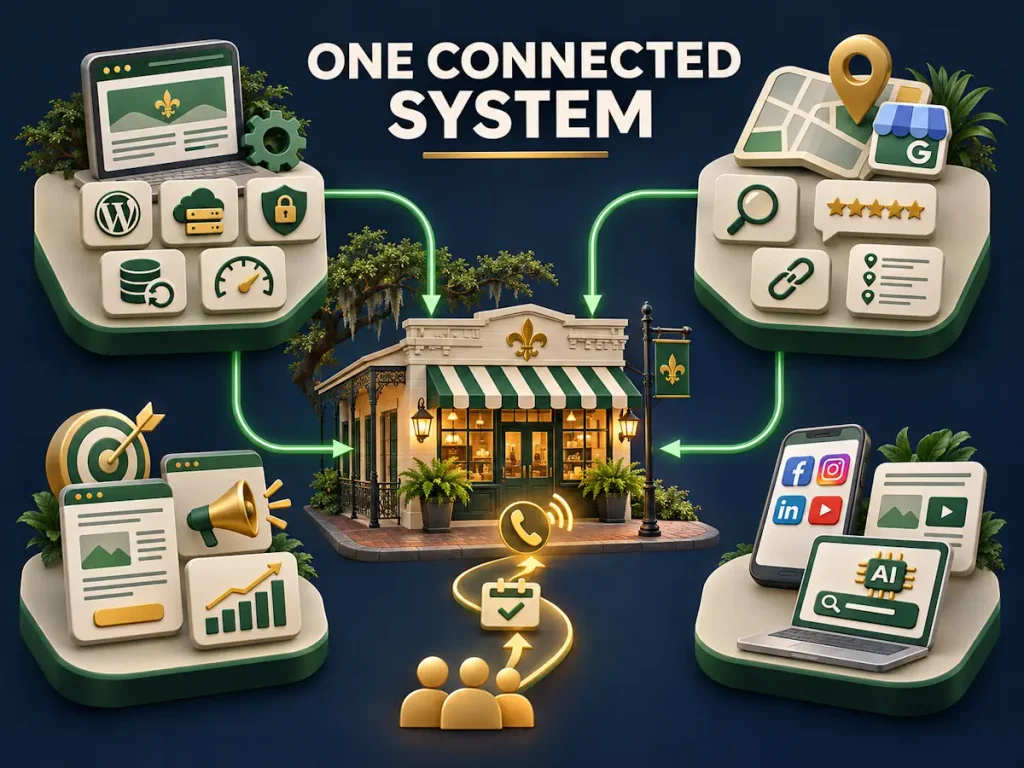
Most owners do not hire twenty vendors. They hire three or four, usually a web designer, maybe an SEO, a host, and somebody for ads. The other sixteen jobs get done badly or not at all, because nobody owns the pieces you never bought, so they quietly rot. The site has not been patched since it launched. Nobody has touched your citations since 2019. Your profile still says you close at 5 when you close at 4. Review requests stopped the month the last marketing person left.
The worst of it is invisible. If your site has been hacked, you probably will not know. The usual version is not a homepage plastered with spam. It is one extra file, a redirect on a page you never visit, or a link quietly inserted somewhere, sitting there for months while some of your visitors get sent to somebody else’s site. Google’s spam policies treat hacked content and malware as reasons a site can be ranked lower or dropped from results entirely, and most owners first hear about it from a traffic drop, not a warning. We have cleaned up a site that got hijacked through a cPanel login nobody remembered. That one ran for weeks before anyone noticed, and the owner lost sales the entire time. The Security issues report in Search Console is where it shows up, and almost nobody opens it. We wrote a full WordPress security hardening guide because this is the kind of problem that hides until it gets expensive.
Speed works the same way, just slower. A slow site costs you rankings, and it costs you customers, and page experience and Core Web Vitals are part of how Google evaluates a page. On a split stack, nobody owns speed. The host says the site is heavy, the developer says the host is slow, and your visitors leave before either of them decides.
The vendors you did hire have their own problem: none of them owns the outcome. When the phone goes quiet, the SEO says the site is slow. The web designer says it is the host. The host says it is a plugin. The ads person says the clicks are fine and the landing page does not convert. Four opinions, four invoices, and you end up as the unpaid project manager of your own marketing.
One team fixes this by making the pieces agree with each other. The site is built for search from the first line of code. The Business Profile matches the site. Reviews feed the profile. Directories confirm the same name, address, and phone. Ads land on pages built to convert. And when something breaks, there is one number to call. We put it this way in the book: “one person has to own the whole loop.” If you hire it out, it should be one provider accountable for all of it, “not five vendors each accountable for a slice.”
Most buyers never check this one. It decides whether you get results or a nice-looking invoice.
Plenty of Louisiana agencies are marketing companies that added SEO. They are good at branding, print, video, social, and paid media, and somewhere on the services page there is a line that says SEO. Not a knock on them, just a warning about fit. When search is one of twelve services, the person running your campaign may be a generalist, and your account is one more thing on their list.
You want a company whose foundation is search. Four quick tests:
What were they built as? A company founded as a search firm treats rankings, entities, and local visibility as the product. A creative shop treats search as one line item inside a bigger retainer.
Does their own search work hold up? This is the fastest test there is, and almost nobody runs it. Look up their Google Business Profile. Is it complete, with recent reviews and real photos? Do they show up for their own city plus their own service? Does their site load fast and say plainly what they do? An SEO company that cannot show up for itself is telling you something.
Who actually does the search work? A named person whose job is search, or whichever account manager is free this week? Ask before you sign.
Is search the product, or the filler? In a paid media shop, SEO is often what keeps the retainer going between ad campaigns. In a search-first shop, it is the reason the company exists.
The second mismatch is quieter, and it costs small businesses a lot of money.
General SEO is built for national brands and online stores: crawling and indexing, site architecture, content at scale, digital PR, domain authority. That work is real, in its own context.
Local SEO runs on three different things: proximity to the person searching, relevance to what they asked for, and prominence, meaning how well known and how well reviewed you are. The work is your Business Profile, your reviews, your citations, service pages that are genuinely unique, local links, and whether AI engines can read and verify your business at all.
The data backs this up. Whitespark’s 2026 Local Search Ranking Factors report had 47 local search experts score 187 ranking factors, and for the first time it scored every one of them for AI search visibility as well as the map pack. Review signals and behavioral signals gained weight this edition, while on-page and link signals slipped. The AI findings are even sharper. Three of the top five factors for showing up in AI answers are citation factors: being named on expert curated “best of” lists, prominence on industry relevant sites, and mentions in newspapers, blogs, government sites, and industry associations. The report’s own summary: “In AI SEO, mentions (citations) are the new link.” The other two top five factors are a dedicated page for each service you offer and the authority of the third-party sites where your reviews live.
Read that list again and notice how little of it happens on your website. A general SEO consultant will do the website work and skip the rest, or worse, clone one page across forty town names and call it local SEO. Google’s spam policies call that out by name, and it can drag your whole site down with it.
So ask two questions on the first call. What will you do in my first 30 days on my Google Business Profile? And how much of your work happens off my website? If the whole answer is about the site, you are talking to a generalist. As we wrote in the book, “A provider who only talks about your site is working on the smallest part of your digital footprint.”
It covers Google and AI together. BrightLocal’s 2026 consumer research found that 45 percent of consumers now use AI tools to get local business recommendations, up from 6 percent a year earlier. AI is now the third most used source for local recommendations, behind only Google and Facebook and ahead of Yelp and TripAdvisor, with ChatGPT used by 31 percent and Google’s AI Mode by 23 percent. Meanwhile, the share of consumers reading reviews on Google slipped from 83 percent to 71 percent. People are not abandoning Google. They are looking in more places.
Reviews still decide who gets picked. BrightLocal’s main survey found 97 percent of consumers read online reviews, and 88 percent fact-check the reviews an AI tool cites.
Where those reviews live, though, changes how much they count. Other AI tools can read your Google reviews, but they do not give them the weight Google search does. Google built its own results around its own review data, so a strong Google review profile carries you a long way in Google. In an AI answer, that profile is one input among many, and the sources that get weighed most are the ones outside Google. Three of Whitespark’s top five AI visibility factors are mentions and citations on other sites, and a fourth is the authority of the third-party sites where your reviews appear. One review platform is a single point of failure. Reviews in other places matter more, and reviews on the industry sites, the directories, and the platforms your customers actually use are what make an AI tool willing to name you. The honest version of the advice is not “get more Google reviews.” It is get reviews everywhere.
It shows you the system in writing. Most agencies guard their process like a trade secret, and you find out what you bought after you pay. Google’s own guidance on hiring an SEO says to “be careful if a company is secretive or won’t clearly explain what they intend to do.” Ask any agency to show you, in writing, what happens in month one, two, and three. If they will not, ask what they are protecting.
You own everything. Your domain, your site, your hosting, your Business Profile, your analytics. Access is ownership. If you cannot get into your own accounts without asking permission, you do not own your own presence.
And you can leave with it. This matters most on the day you decide to go, which is the day some agencies make it expensive on purpose. The website was built on their platform, so it cannot move to another host. The domain is registered in their name, so your site disappears when you stop paying them. The content you paid for arrives as a PDF instead of files you can edit. Your Business Profile sits inside their account rather than yours, and getting it back turns into a negotiation. None of that is a mistake. Call it a retention strategy. It works because most owners only find out after they have paid. Ask any agency three things before you sign: whose name is on my domain, can my site move to another host, and what does it cost me to leave. If the answer is anything other than you own all of it and you can take it with you, keep looking. That is our rule too. You own everything we build, and if you ever leave, you take all of it with you.
You can talk to them between reports. A lot of agencies onboard you, go quiet, and send a report at the end of the month. Others run on a ticket queue, and a simple question can sit for a day or more before a person answers it. A report tells you what already happened, and a queue tells you where you are in line. You want a team you can ask a question the day it comes up and get an answer from someone who knows your account. Ask for that before you sign, then watch how fast they answered your first email. That reply speed is the preview of the service.
It gives you an honest timeline. Anyone selling local SEO without one is either new or not being straight with you. More on what honest looks like below.
Search for an SEO agency in Louisiana, and you will see the same names, mostly on directories like Clutch, DesignRush, Sortlist, and Expertise. Those directories are paid listing services, not consumer reports, but the firms below are real; they have real track records, and the fastest way to judge fit is to see who each one is actually built for.
I have not done work at any of these shops. I am going by their own websites and their public review profiles, and I name the source wherever there is one, because review counts move. Some of what follows also reflects what we have heard from business owners who worked with these firms, usually in a conversation that started because they wanted something different. I have kept that general and unnamed on purpose, because those are other people’s experiences rather than published facts, and I am not repeating anything I cannot stand behind. If your own experience with one of these firms is different, you are the better source.
And to be clear about intent: none of this is meant to put anybody down. Every one of these firms has a real track record, and for the right business several of them are a better choice than we are. Read every “not the best fit” line as being about fit, not quality. I am not in the business of trashing my competition. It is a small state, most of these people are neighbors, and a page that wins by making everyone else look bad is the same kind of trick this post tells you to walk away from.
Gatorworks is the name that comes up first in most Louisiana lists, and it earns the spot. It is a Baton Rouge digital agency with an in-house team and a wide menu: web design, SEO, Google Ads, paid social, streaming TV and audio advertising, AI optimization, even manual ADA remediation. It holds a 4.9 average across its verified Clutch reviews and a BBB A+ rating.
Best fit: established organizations with a real multi-channel budget that want one strong shop for all of it. Probably not the best fit: a single-location business spending a few hundred dollars a month, which is not the account a firm this size is built around.
Search Influence is a woman-led New Orleans agency with a genuine specialty instead of a service list. Its own homepage leads with AI driven SEO and digital advertising for higher education and healthcare, and its testimonials come largely from universities and health organizations, with reviewers praising data and communication.
Best fit: colleges, health systems, senior living, and tourism organizations with committees and institutional budgets. Probably not the best fit: a one location restaurant or contractor, who would be paying for institutional process they do not need.
Click Here Digital is one of the biggest and most established shops in the Baton Rouge area, with more than thirty years in digital advertising and a focus on automotive and RV dealers, law firms, and enterprise brands. Its site cites 655+ third-party verified reviews and a 4.9 out of 5 Google rating, and it built its own marketing intelligence platform, ClickIQ, which is genuinely useful at that scale.
Best fit: dealerships, multi-location groups, and high-competition verticals with a serious monthly media budget. Probably not the best fit: a single-location small business, which would be shopping several weight classes up.
Catapult is a full-service agency with a creative engine: branding, websites, SEO, PPC, content, video production, print, and promotional products. It shows a 4.8 Google rating on its own site, and its portfolio runs from ecommerce brands to engineering firms.
Best fit: a business that wants branding, print, video, and web from one creative shop. Probably not the best fit: an owner whose main need is ranking in a service area, since SEO is one service among many there.
Online Optimism is headquartered in New Orleans with a second office in New York and a distributed team. It covers a wide online marketing menu, including SEO and answer engine optimization, Google Ads, social, Reddit, WordPress and Shopify builds, video, email, and branding. Answer engine optimization sits right on its services list, which is more current than most.
Best fit: brands and organizations that want a broad, modern marketing partner with real creative range. Probably not the best fit: a one location local business looking for a local search specialist.
Firefly is a downtown Lafayette agency with more than twenty years in business, doing web design and development, SEO, social, and paid ads. It has strong Google reviews, and if you are in Acadiana, it is worth a conversation.
Best fit: Acadiana businesses with a meaningful project budget. Probably not the best fit: an owner looking for a few hundred dollars a month, since Clutch lists its minimum project at $5,000 and its average rate at $200 to $300 an hour.
Design225 is the closest to us philosophically, so treat this as a direct comparison. Its own pitch is “one team builds the site, then keeps the phone ringing,” with the same in-house Baton Rouge team doing the build, the local SEO, and the monthly work, and a service area running from Baton Rouge to Lafayette, New Orleans, Lake Charles, and Shreveport. Same one-team idea this whole page argues for, and I respect it.
Best fit: a Baton Rouge area business that wants a website and local SEO from one local team. If both of us fit you, compare the systems side by side and pick on trust and what you get for the price.
Norzer is us, so weigh this entry knowing that. We are a local search agency built around one idea: one team owns your whole digital presence, and most of the work happens off your website, where Google and AI tools look for proof that your business exists, is reviewed, and is real. We run four connected pillars: your Entity Home (the website as the single source of truth for the business), your Google Business Profile, your Niche Authority across directories and local platforms, and your Digital Presence. We wrote the entire system down in Halo One, so you can read how we work before you pay us anything.
We are on this list because leaving ourselves out of it would be its own kind of dishonesty. We are last, not first, and everything we say about the other firms is written the same way as what we say about ourselves. The long version, including the clients we are the wrong fit for, is further down the page.
Best fit: an owner-operated small business with one location or one defined service area that wants local search and AI visibility run as a single system, at prices published on our site. Probably not the best fit: multi-location and franchise businesses, national campaigns, and owners who want to hand the whole thing off and never look at it.
Notice what the directories do not tell you. They rank by who pays and who has the most reviews, not by who fits a small business best.
Start with Google’s own list. Google’s guidance on hiring an SEO suggests asking: Can you show me examples of your previous work? Do you follow Google Search Essentials? What results do you expect, in what timeframe, and how do you measure success? What is your experience in my industry and my city? How long have you been in business? How will we communicate, and will you share every change you make to my site and why? Google also says to check references by asking past clients whether the service was useful, and, if an agency offers an audit, to give it read access to Search Console only, not write access.
Then add these, because they are the ones that sort small business agencies from everyone else:
1. Who owns the accounts and the website? The right answer is you, with the agency working inside your access. If they own your domain or your Business Profile, you are renting your own business.
2. Is your foundation search, or is SEO one of your services? Ask what the company was founded as and how much of its work is search.
3. What will you do on my Google Business Profile, and how much of your work happens off my website? Vague answers mean website only.
4. What exactly will you do for AI search? Not a buzzword, a mechanic. How do they get you named on the sites AI tools trust, and how would they show you movement? Google’s guidance asks whether an agency’s AI advice lines up with Google’s own documentation, which is a fair test.
5. How do I reach you between reports? A private chat with the team, a phone number that reaches a person, or an account manager who answers in three days?
6. What is the contract term, and how do I leave? Month to month with a clean exit is a shop confident in its work. A 12-month lock-in with auto-renew is a shop protecting its revenue from its own results. Then ask what the exit actually costs. Whose name is the domain in, can the site move to another host, and do you get the files, or just a login you lose the day you stop paying?
7. If the calls slow down, who is responsible for finding out why? This one comes straight from our book, and it is the one I would ask first. If the answer is anything other than “we are,” keep looking.
Norzer is a local digital authority builder for small businesses, based in Baton Rouge. We work with clients all over the United States, not just Louisiana, and primarily with owner-operators who have a physical location or a defined service area: contractors, restaurants, medical practices, service providers, specialty retailers, and businesses like them.
We wrote the book, and you can read the whole system before you hire us. Halo One is our entire method, published, with a free companion page holding every prompt, the 30-check audit scorecard, the hours worksheet, and the checklists. Writing it down was not a marketing stunt. It was also the fastest way for you to decide whether we know what we are doing, because you can check every claim against the system itself. Our process and pricing and the platform guides we hand clients are public too. Most agencies hide the process. Ours is in print.
Local search is the foundation, not the upsell. Norzer was built as a local search company. We do not run national indexing programs or enterprise content engines. We run one business, in one market, and the local work that decides whether that business gets the call.
One team, one system, one number to call. Website and hosting, security and updates, local SEO, your Google Business Profile, citations and directories, your review system, content, Google Ads when you want them, and AI search visibility. It all runs as four connected pillars: your Entity Home (the website as the single source of truth for your business), your Google Business Profile, your Niche Authority across directories and local platforms, and your Digital Presence. When something breaks, we own the fix, because there is nobody else to point at.
Google and AI on purpose. We make your business easy for AI tools to read and verify, and we work on the off-site mentions and reviews they actually draw from. We do not promise you a spot in anyone’s AI answers, because nobody can.
One business per niche per zip code, nationwide. If we take you on, your direct local competitor cannot hire us while you are a client. That is why we turn work down.
You see the homepage before you pay. We build your Entity Home homepage first and put it in front of you. You pay nothing until you have seen it and approved it.
No contracts, and you own everything. Monthly plans are month to month, cancel any time. If you are not happy with a month of work, we refund the last month. You stay because of results, not paperwork.
You are not waiting on a monthly report. Every client gets a private chat room with our team, and the room stays open. No ticket queue, no portal, and no waiting for the next report to ask a question. When a question comes up, when a new competitor opens down the street, or when you want to know why something changed, you ask and we answer.
Published prices, and automation keeps them down. Halo One, our full install, is $3,333, currently offered at $2,222. Monthly plans run $500, $1,000, or $2,000, and every plan runs the same system. The price buys speed, not scope. Hosting and management, our Vessel layer, runs $25 to $99 a month. Our research, content production, monitoring, and reporting run on systems we built ourselves instead of a room full of account managers, which is why we usually come in well under what larger firms charge for the same work. Cheap is not the goal, and you should judge any agency on the work, but a smaller price here does not mean less of the system.
We send a gift and ask for nothing. Every new client gets a box with a signed copy of Halo One, a few Louisiana things, and a hand-written note. No logo on any of it, and no request for a review or a referral, because a gift with an ask attached is an advertisement, and asking for reviews that way is against Google’s rules and the FTC’s.
The people are the credential, and I would rather show you why than tell you. I have over 25 years in IT, including enterprise data center work at IBM and Northrop Grumman, and I do the work with a small team led by our lead developer and co-author, Dylan Van Der Westhuizen. We both hold the Certified Google AI Professional credential. The part that matters for this work is that I have spent my life taking complicated systems apart to see how they run, starting with a Commodore 64 at about ten and a phone phreaking habit in the eighties. Local search is one of those systems. Once you can see the pieces, the order to do them in stops being a mystery, and mystery is what most agency pricing quietly depends on.
The results are published. Santa Year Round, a Louisiana business, leads AI Share of Voice across every competitor for Louisiana Santa searches. Mizak & Pacetti went from one or two clicks a day to more than 20 a day on average, with peak days over 50. Both are on our case studies page.
Now the part most agencies leave out.
We are not a good fit for larger clients. If you have multiple locations, a franchise footprint, a national campaign, a seven-figure ad budget, or a marketing department with brand guidelines and legal review, hire one of the firms above. They are built for that, and we are not.
We are not a good fit if you want to hand it off and never think about it. This work takes one to three hours a week from you: reviews, photos, customer questions, feedback on content. Not a lot, but not zero either, and we would rather say that now than after you pay.
We are not a good fit if you want a trick. We do not do anything on the red flag list. If what you want is a shortcut, we will tell you so on the first call.
Local SEO is not fast, and no agency changes that. Early movement in Google Business Profile impressions and website traffic usually shows in 60 to 90 days. Good results usually show in 3 to 6 months. Full local domination usually takes 6 to 12 months. Those are common patterns, not guarantees, and every market is different. A town with three plumbers moves faster than New Orleans or Baton Rouge, where you are up against competitors with hundreds of reviews.
And do not judge the strategy in under three months. Local search compounds, and a shop that changes direction every month never gets to the part where it works.
That is a real option, and Google says so itself: “If you run a small local business, you can probably do much of the work yourself.” We agree, which is why the book exists. Halo One is the same system we run for clients, written for owners, and the companion page is free whether or not you buy it. Start with the 30-check audit scorecard. Then run your site through our free AI Readiness Checker to see how AI tools read your business. Between the two, you will know more in 20 minutes than most sales calls will tell you in an hour.
Enough that real work happens, and no more than the leads are worth to you. Some full-service Louisiana agencies list project minimums of $5,000 or more on Clutch, while shops that focus on small businesses like ours publish monthly plans starting at $500. Be suspicious of any price that looks like a bargain against what a month of real work involves.
For a single-location business, you want local. General SEO focuses on your website. Local SEO covers your Google Business Profile, reviews, citations, service area pages, and how you show up in the map pack and in AI answers, and most of that happens off your website.
A marketing agency sells a retainer with SEO as one line item among many. An SEO company’s whole business is search. Ask what the company was founded as, and look at whether its own Google Business Profile and website hold up.
One accountable team, in most cases. A single-location business has roughly twenty moving pieces, and splitting them across vendors means several invoices, conflicting priorities, and a blame chain the first time results slip. It also leaves the jobs nobody was hired for, like security patches and citations, to quietly rot.
Early movement usually shows in 60 to 90 days, good results in 3 to 6 months, and full local domination in 6 to 12 months. Those are common patterns, not guarantees.
No. Google’s own guidance says no one can guarantee a #1 ranking. What an honest agency can do is make your business consistent, clear, and well-reviewed everywhere Google and AI tools look.
They pull from many sources at once, including directories, review sites, news, best of lists, and your own website. Whitespark’s 2026 survey of local search experts found that three of the top five factors for AI visibility are citations and mentions on other sites, so most of the work is off your website.
Ask what it has published and ask to see its system in writing. Check its own Google Business Profile and its case studies, and call past clients. We wrote our entire system down in a book, which is the clearest proof we can offer.
Yes. Local search is local to your customers, not your vendor. A Louisiana agency just knows the seasons, the neighbors, and the language of your market without needing a lesson.
If you run a small business inside or outside of Louisiana and want help getting found on Google and named in AI search, that is what we do. The first step is a free consultation where we look at your actual footprint and tell you what we would do.
Even if you hire someone else, take the questions above with you. And if you want to see how we work before you talk to anybody, read Halo One or start with the free audit scorecard on the companion page.
We take one business per niche per zip code, so your spot may be open, or it may not be. Either way, we will tell you straight.