Google Ads in Small Towns: Stop Chasing Volume and Own the Top of the ...
Most Google Ads advice is written for businesses in big markets. Read enough of it and you’ll ...

Ryan McCain

I asked ChatGPT for the best plumbers in Baton Rouge. It gave me four names, and a plumber I know does good work wasn’t on that list. All four had the same four things: a website that says plainly what they do and where, matching details on every listing, plenty of reviews, and full profiles on the sites ChatGPT reads.
This post uses that one search to show how ChatGPT recommends local businesses, one step at a time. You can run the same test on your own business tonight. It takes about ten minutes.
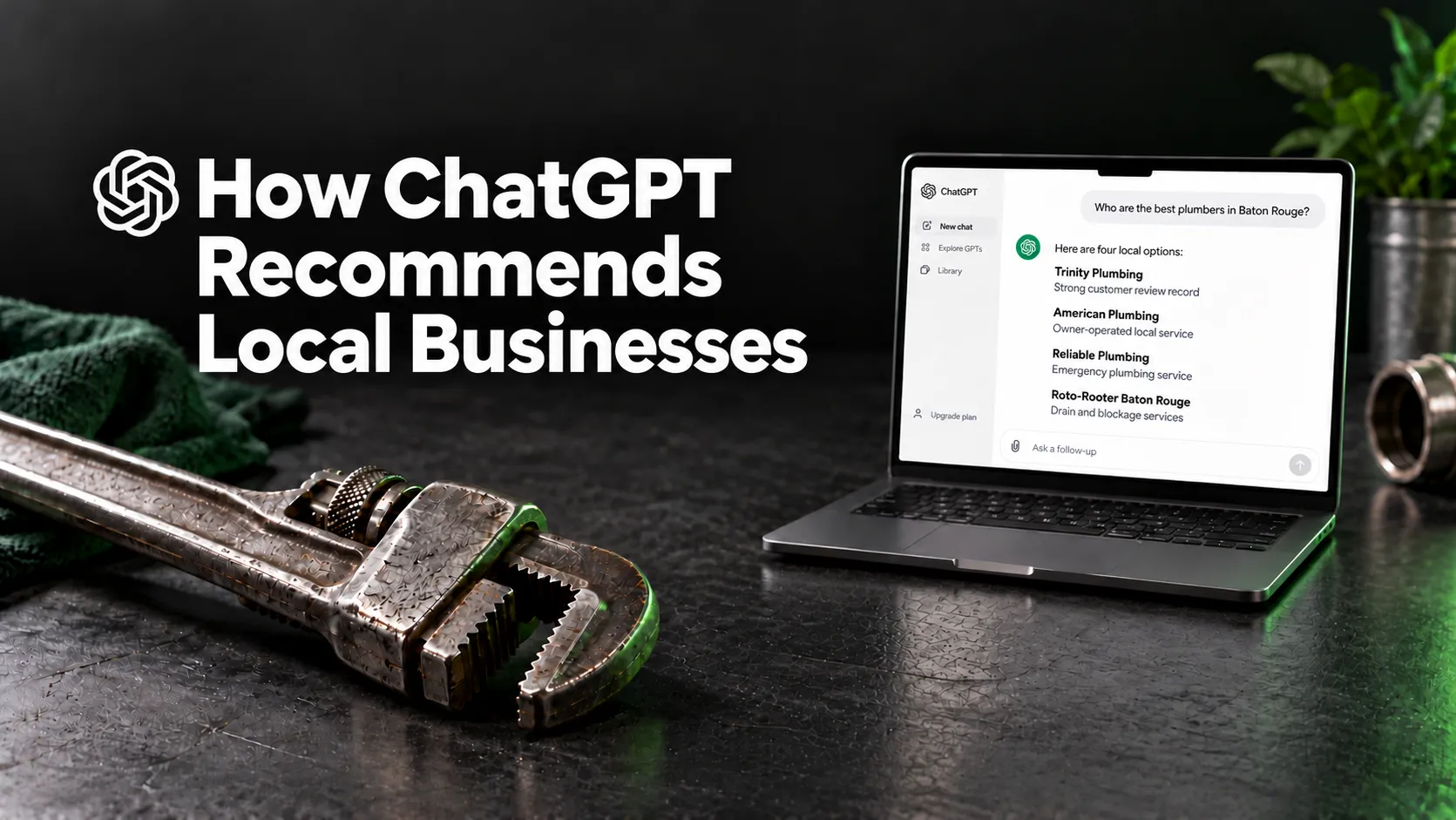
Hi! I’m Dylan. And to be honest, nothing in my house was leaking. Out of curiosity, I wanted to see what a customer sees when they skip Google and ask an AI for the answer. A lot of people do that now. BrightLocal’s latest consumer survey found that 45% of US consumers use ChatGPT or a tool like it to find local businesses. The year before, it was 6%. So I opened ChatGPT and typed what a person with water on the kitchen floor would type: “Who are the best plumbers in Baton Rouge?”
About a minute later I had four names, each with a line about why.
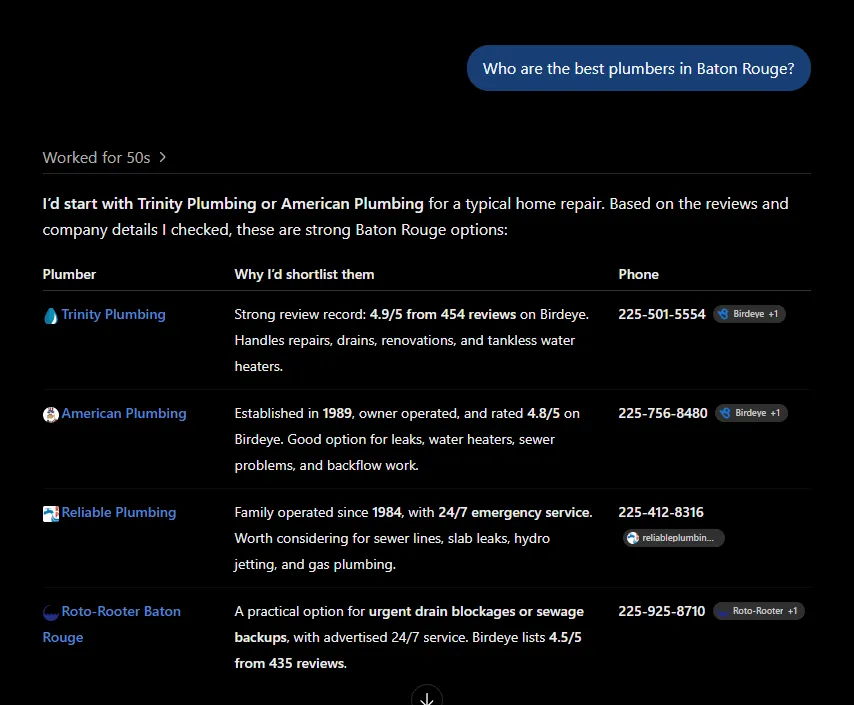
Immediately, I noticed that my go-to plumber wasn’t listed. AttaBoy Plumbing wasn’t there, and I know they do genuinely good work.
That bothered me. A real customer would have called one of those four and never heard of AttaBoy plumbing.
I typed a second question: “What sources did you use to decide?”
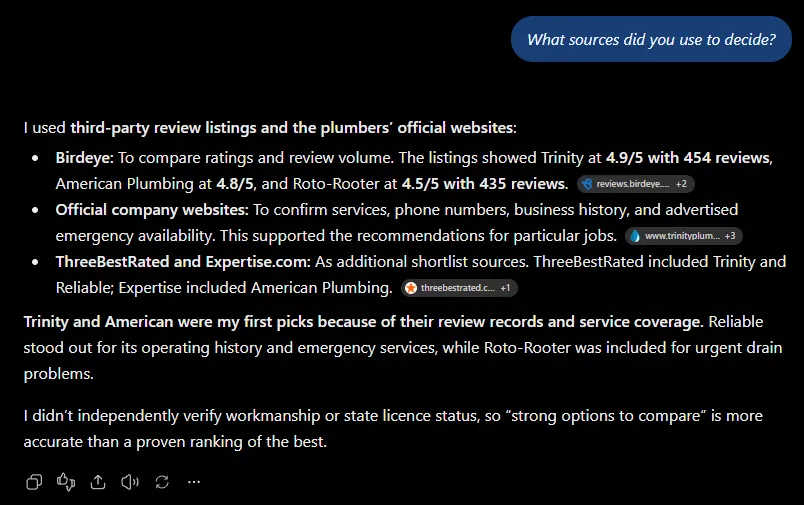
ChatGPT gave me its sources: Birdeye, a site that collects customer reviews, the plumbers’ own websites, and two shortlist sites, ThreeBestRated and Expertise.com.
If you own a business, read that list slowly. ChatGPT has never had a burst pipe. It has never hired a plumber, so it has no opinion of its own about who is good. It goes and reads what is already written about you online. Then it repeats what those places agree on. That, in short, is how ChatGPT recommends local businesses.
So you don’t need ChatGPT to like you. You need those places to say the same good things about you.
I didn’t take ChatGPT’s word for it. A chatbot can sound sure and still be wrong, so I looked up all four businesses myself, using the checks from our book, Halo One. Four things kept showing up.
On each site, I knew within seconds what the business did and which areas it covered. I didn’t have to scroll. The top of American Plumbing’s homepage read: “Plumbing, Rooter and Backflow Services for Baton Rouge, LA”. Right under it was a reason to pick them, with proof behind the reason: “Bonded & Insured – Licensed Master Plumbers – Owner Operated”, then “Licensed Master Plumber Since 1989” and a license number.
Look back at what ChatGPT said about American Plumbing: established in 1989, owner operated. Both facts are sitting at the top of that homepage. ChatGPT loves data like this.
The proof matters more than the claim. Anyone can write “best plumber in town”. In my own tests, AI tools pass over a line like that unless they can see something that backs it up.
On your own website, open your homepage on your phone. Without scrolling, can a stranger tell what you do, where you do it and why they should pick you? If not, rewrite the top of the page until they can.
Here’s a prompt you can use: Write Homepage and Service Page Copy That Ranks and Gets Quoted by AI. It drafts one page at a time for you.
Next, I checked each business’s name, address and phone number in three places: their website, their Google Business Profile, and the sites ChatGPT had named. For all four plumbers, everything matched, down to the last digit of the phone number. The numbers ChatGPT gave me were the same ones at the top of their websites. This means that the top-ranking businesses were consistent across all citations.
That sounds small. But ChatGPT repeats what places agree on. If your website shows one phone number and an old directory shows another, those places disagree, and ChatGPT has less reason to trust either of them.
Test it for your own business: search for your own business name. Open every listing you find. Fix each one that shows an old address, an old number or a slightly different name.
Our prompt makes the search much easier: the Norzer Local SEO Citation Auditor checks your name, address and phone number across directories and review sites and gives you a list of conflicts to fix. Find Your Business’s Independent Digital Footprint finds mentions of your business on sites you don’t control.
All four had plenty of reviews. On Google, Trinity Plumbing had 597, Reliable Plumbing had 414 and American Plumbing had 339. On Birdeye, Trinity had 454 and Roto-Rooter had 435.
And the review count seems to matter more than you’d think. When 8ight.AI ran this same kind of test on almost 3,000 local businesses, ChatGPT named about one in five of those with 250 to 999 Google reviews. For businesses with fewer than 25 reviews, it named 3.4%. Trinity, Reliable and American all sit in that first group.
What stood out more was the replies. The owners had answered their reviews, the bad ones as well as the good ones.
A reply shows there is a real person behind the business who is still paying attention. Algorithms are trying to find the best real businesses, not the best-optimized websites, and an owner who answers their customers looks like one. Customers think the same way: 80% told BrightLocal they’re likely to use a business that replies to all of its reviews.
What to do: ask every happy customer for a Google review. Then reply to every review you get. Two lines of thanks is enough. (Yelp has its own rules about asking, and our Yelp guide covers them. But the short answer is: don’t ask for Yelp reviews.)
Prompt to use: the Norzer Local FAQ Builder reads your real reviews and customer conversations and turns them into questions and answers for your website, so the proof in your reviews ends up on your own pages too.
Further reading: How to Get More Google Reviews for Your Small Business gives you the full system: the review link, when to send the request, and how to reply.
Remember the list of sources? The winners had a full profile on every one of them. Each Google Business Profile had hours, services, photos and a service area filled in. Three of the four had a Birdeye page, which is where ChatGPT got its star ratings. American Plumbing even shows its Birdeye reviews on its own homepage.
ChatGPT can’t recommend a business it can’t find, and it can only find you in the places it looks.
What to do: claim your profile on every site ChatGPT names for your town, and fill in every field. A half-empty profile gives it very little to repeat.
Further reading: we have a guide for each of the big platforms: Winning on Yelp, Angi, Houzz, Nextdoor and Thumbtack.
I went back to AttaBoy Plumbing, the one I know does good work, and asked: “Why isn’t AttaBoy Plumbing on your list?“
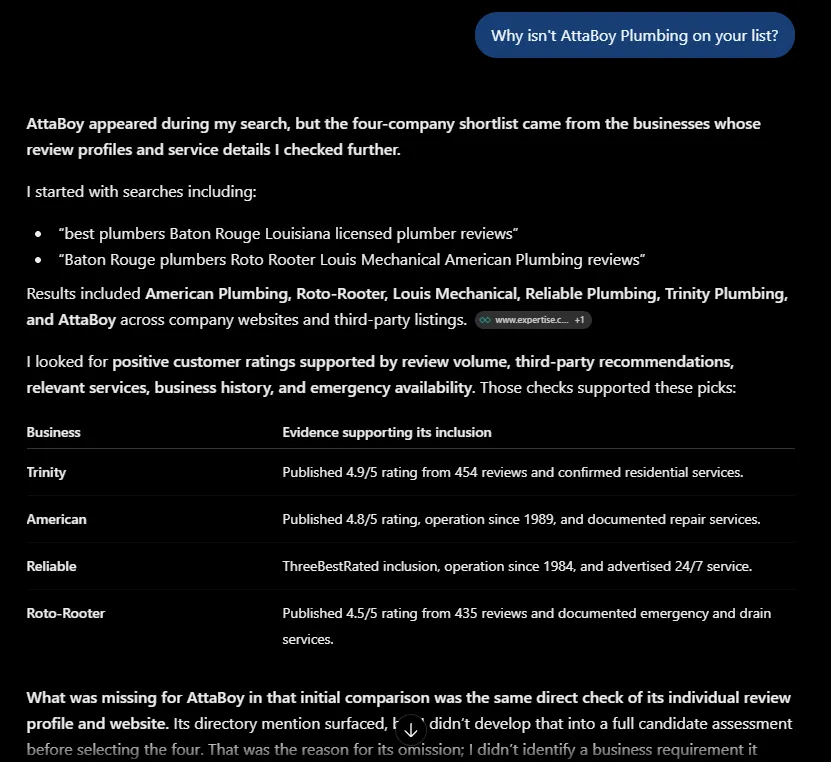
ChatGPT was fair about it. It said AttaBoy Plumbing did come up in its search. The four it picked were simply the ones whose review ratings, third-party recommendations and service details it had checked in more depth.
ChatGPT had no idea how good AttaBoy Plumbing is with a pipe wrench. It can only go on what it finds online, and it found more to read about the other four: more reviews, more third-party recommendations and more detail about their services. That says nothing about the quality of AttaBoy’s work. There’s more to the strategy than just these three things.
A really good plumber can be overlooked if there isn’t enough online for ChatGPT to go on. The customer who asks ChatGPT will never know what they missed.
Does ChatGPT recommend your business? Open it and ask these four questions. Swap in your own service, town and business name.
Some of the answers will sting, the third one most of all. Write them down anyway. Then check them, the same way I checked those four plumbers. ChatGPT gets things wrong, so treat what it says as a lead to follow up. Whatever holds up is your to-do list.
The four questions tell you what is wrong. These prompts help you fix it. Each one is free on our site. You copy it, paste it into ChatGPT, Claude or Gemini, and fill in your business details. Several of them need deep research or web search switched on, so check the page before you run one.
Run them in this order:
A prompt gives you a draft, and you still have to check it. You know your business and the AI doesn’t, so read every line before it goes on your website.
I can’t promise you a spot on ChatGPT’s list, and honestly, nobody can. However, these five things give you a real chance.
Start small. If your business is new or not well known yet, don’t try to win the whole city. Win one neighborhood first, especially if it’s a crowded market. Become the plumber (or the roofer, or the dentist) that one area talks about, then widen the circle over time once you start ranking in that neighborhood. You still take the calls from further out. One neighborhood is only where you start.
Fix your Google Business Profile and keep it active. Fill in every field. After that, add photos and updates as you finish jobs, so the profile never looks abandoned.
Make your facts match everywhere. One name, one address and one phone number, on every site that lists you.
Build reviews steadily. A few new reviews every month, all year, looks like a busy business. A pile of them in one weekend followed by months of silence does not.
Skip the “AI SEO package” pitches. If someone offers to get you into ChatGPT with a secret method and a monthly fee, keep your money. There is no trick. Everything those four plumbers had was the basics, done properly and kept up.
If I owned a good local business like AttaBoy Plumbing, I know what I’d do first thing tomorrow. I’d search for my own business name and make sure every listing says the same thing. It costs nothing and takes an afternoon. And the rest of the work pays off faster once ChatGPT sees one clear set of facts about you.
Our book, Halo One: The Small Business Playbook for Getting Found and Generating Real Leads from Google and AI Search, covers every step in this post in a lot more detail. If you would like us to run this check on your business for you, book a Halo One audit.