Last updated: April 2026
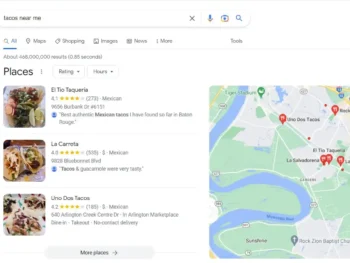
You did everything right. Your site climbs to the top of Google. Traffic is steady. Leads are coming in.
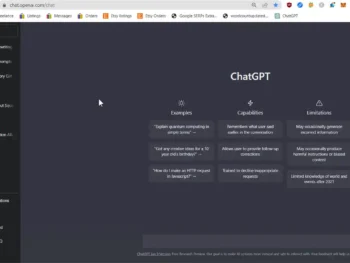
Then your prospect opens ChatGPT, asks a question about your industry, and your business isn't mentioned anywhere in the answer. Not once.
This isn't hypothetical. According to research from GEO firm Brandlight, the overlap between top Google links and AI-cited sources has dropped from 70% to below 20%. The sites getting cited by AI aren't necessarily the ones winning on traditional SEO. And nearly 68% of sources cited in Google's AI Overviews don't even rank in the top 10 organic results for that query, per Surfer's analysis.
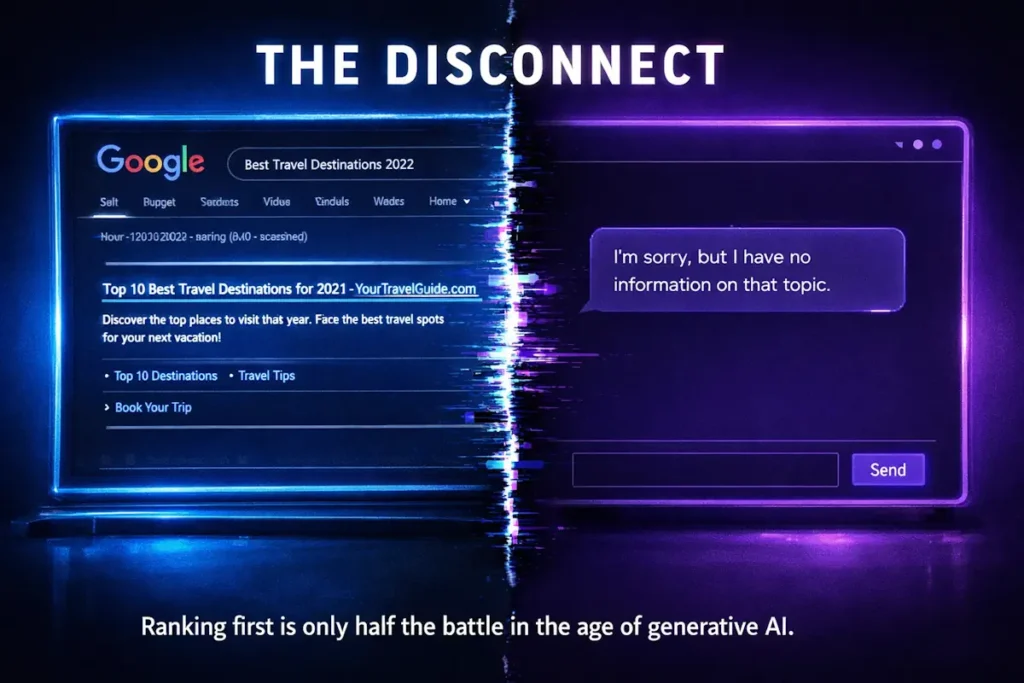
The industry calls this Generative Engine Optimization, or GEO. It's the practice of making your content visible not just to Google's traditional index, but to ChatGPT, Perplexity, Gemini, Google AI Overviews, and Claude when they stitch together answers for your potential customers. This isn't replacing SEO. It's an additional layer on top of it.
And for new businesses trying to build their digital footprint, ignoring AI visibility is leaving money on the table.
The Scale of the Shift
Let's put some numbers on this so it doesn't feel abstract.
As of Q1 2026, AI referral traffic accounts for 1.08% of all web traffic across 10 major industries, per Conductor's benchmarks. That number sounds small until you realize it's growing exponentially. ChatGPT alone drives 87.4% of all AI referral traffic. Google AI Overviews now trigger on roughly 25% of all searches, nearly double the rate from late 2025.
Here's the number that should really change how you think about this: 93% of AI search sessions end without the user visiting a website at all. They get their answer and move on. If your brand isn't part of that answer, you don't exist in that interaction. There's no "page two" to scroll to. There's no second chance.
The GEO market is projected to hit $33.7 billion by 2034. This isn't a fad. It's the next major channel for customer acquisition, and the businesses that build citation authority now will compound that advantage the same way early SEO adopters did in the 2000s.
Step Zero: Make Sure AI Can Actually Read Your Site
Before we get into optimization tactics, there's a prerequisite that trips up more businesses than you'd expect: AI crawlers might be blocked from reading your site entirely.
This is especially common for sites using Cloudflare. In mid-2025, Cloudflare changed its defaults so that new domains block all known AI crawlers automatically. If your site runs behind Cloudflare and you haven't explicitly allowed AI search bots, your content is invisible to ChatGPT, Perplexity, and Claude right now.
There's an important distinction most people miss: AI search bots and AI training crawlers are different things. Search bots like OAI-SearchBot, ChatGPT-User, and PerplexityBot index your site so it can appear in AI-generated answers and send referral traffic. Training crawlers like GPTBot and CCBot scrape your content to train models and generally send nothing back.
You probably want to allow the search bots while blocking the training crawlers. Check your robots.txt and your Cloudflare settings. If you see a blanket block on AI bots, you're cutting yourself off from the fastest-growing discovery channel in search.
For WordPress sites, this is a five-minute fix that can have an outsized impact. We check this for every new Norzer client before we touch anything else.
Now, Here Are 7 Ways to Get Your Business Cited by AI
1. Structure Content for AI Extraction
This comes first because it's the foundation everything else builds on. AI doesn't read your pages the way a human does. It pulls short sections, typically 75 to 225 words, that can stand alone as self-contained answers.
Over 72% of pages cited by ChatGPT contain a short, direct answer immediately after a question-based heading, according to Search Engine Land. The format that works: the heading states the question, the first sentence answers it directly, and the following text adds context. One idea per paragraph. No burying answers under filler.
The industry calls this the "Answer-First" framework. Start your articles with a 40 to 80 word summary that directly answers the primary query. Then expand.
This also means thinking about your content in terms of "extractability." Can AI pull a clean, quotable chunk from your page? Or is the answer buried in paragraph six after a long anecdote? Write so that every section could function as a standalone answer if it were yanked out of context.
This isn't just good for AI. It's good for humans too. Clear, direct, well-structured content performs better everywhere.
2. Add Schema Markup
Schema markup gives AI systems structured data about what your page is, who created it, and what it covers. It's metadata that makes your content machine-readable in a way that plain HTML doesn't.
Proper schema can deliver up to a 10% visibility improvement on Perplexity, per ConvertMate's analysis. The schema types that matter most: Article, FAQPage, HowTo, Organization, Product, and LocalBusiness.
One healthcare system, Sharp HealthCare, implemented schema across its health content and saw an 843% increase in clicks from AI search features within nine months. That number is real.
At Norzer, we implement schema as raw JSON-LD directly on client pages. Entity-level schema (Organization, LocalBusiness) lives on the homepage. Individual service pages carry their own Service schema with a provider back-reference to the homepage entity. FAQPage and HowTo schema go on content pages where they fit naturally. It's not glamorous work, but it's one of the highest-leverage technical fixes you can make.
3. Publish Original Data
AI loves data it can quote directly. Content with specific statistics or direct quotations shows a 30 to 40% increase in AI visibility, even without any other changes, according to a Princeton study. And 67% of ChatGPT's top 1,000 most cited pages come from original research or first-hand data, per Ahrefs.
This is one of the biggest advantages small and local businesses don't realize they have. A staffing agency that can say "we reduced cost-per-hire by 34% in Q3" gives AI something concrete to cite. A marketing agency that publishes actual campaign results with real numbers becomes quotable. Vague claims about being "the best in the business" give AI absolutely nothing to work with.
Run surveys. Publish case studies with real numbers. Share results from your actual campaigns or projects. Format the findings in clear, extractable sections so AI can pull them cleanly. This is why we push every Norzer client to document their results, even early on. That data becomes a compounding asset.
4. Build Topical Depth for Query Fan-Out
When someone asks ChatGPT a question, it doesn't just process that one query. It breaks it into 5 to 10 sub-queries behind the scenes. If someone asks "What's the best digital marketing agency for a new restaurant in Baton Rouge?" the AI might separately search for "digital marketing new restaurant," "restaurant marketing Baton Rouge," and "website design for restaurants" as independent queries.
Ranking for those sub-queries makes you 49% more likely to be cited, per Surfer's data. Ranking for both the main query AND its fan-outs? 161% more likely.
This is where content strategy gets tactical. Map out the sub-questions AI would generate from your core topics. Build content clusters. Don't just answer the main question. Answer the questions behind the question.
For our clients launching new businesses, this means we don't just build one page about their service. We build a web of content that covers every angle AI might explore. A pest control company doesn't just get a homepage. They get content addressing seasonal pest patterns, prevention tips, specific pest identification, commercial vs. residential approaches. Each piece feeds the fan-out.
5. Get Visible Beyond Your Website
AI pulls citations from all over the web. Not just your site.
Brands with active profiles on review platforms like Trustpilot, G2, and Capterra reportedly have a 3x higher chance of being cited by ChatGPT. On Perplexity, nearly half of top citations come from Reddit, and about 14% come from YouTube. According to Conductor's data, branded web mentions have the strongest correlation (0.664) with AI Overview appearances, making digital PR and brand visibility particularly important.
Your website is home base, but it can't be the only place you exist online. Participate on Reddit where your audience hangs out. Publish YouTube content that answers real questions. Keep your review profiles active. Get mentioned on industry sites, local news, and relevant directories.
Semrush's own case study showed they nearly tripled their AI share of voice from 13% to 32% in a single month, and a major part of their strategy was optimizing presence on third-party platforms like Reddit, Quora, and LinkedIn, not just their own blog.
The more places AI can find your brand saying something useful, the more likely it is to cite you.
6. Keep Content Fresh (and Keep Proving It)
AI assistants prefer newer content. Ahrefs found that AI-cited content is roughly 26% fresher than what typically shows up in organic search results. On Perplexity, freshness reportedly accounts for about 40% of ranking factors.
But here's what makes this urgent: AI citations are volatile. Semrush's AI Visibility Index shows that 40 to 60% of sources cited by AI systems rotate every single month. A page that gets cited today might be replaced next week. This isn't like traditional SEO where a #3 ranking today probably means #3 tomorrow. AI citations are probabilistic, and they shift constantly.
This means content maintenance isn't optional. It's the price of staying visible. Update your most important pages monthly with real, substantive changes. New data points. Revised recommendations. Updated examples. And always include a visible "Last updated" date so both humans and AI systems can see the content is current.
Changing the publish date without actually updating the content doesn't work. AI can tell.
7. Track Your AI Visibility
Here's where most businesses are completely blind. Traditional analytics tell you about organic clicks and traffic. They tell you nothing about whether ChatGPT mentioned your brand when a prospect asked about your industry.
Each AI platform behaves differently. Perplexity leads in citation rate at 13.8% but has 45 million active users. ChatGPT has a citation rate of just 0.7% but dominates with 87.4% of AI referral traffic. Google AI Overviews favor established web authorities. What gets you cited on one platform might not work on another.
Start monitoring how often your brand shows up across platforms. Look for patterns in what's getting cited. Then apply those patterns to the rest of your content.
Tools like Semrush's AI Visibility Toolkit, SE Ranking, and Superlines are purpose-built for this. The GEO tools market has attracted over $31 million in venture funding with 20+ dedicated platforms available. This space is maturing fast.
If you're not tracking AI visibility yet, you're optimizing blind.
The Bottom Line
If you're launching a business or trying to grow one, you can't afford to optimize only for Google anymore. AI search is changing who gets seen, who gets cited, and who gets the lead.
At Norzer, this is baked into everything we do. From robots.txt audits and schema markup to content structure and building the kind of digital footprint that AI systems actually notice. We're not bolting GEO onto existing SEO services as an upsell. It's part of the foundation.
AI is still deciding which sources it trusts. Once those preferences solidify, displacing an established source gets significantly harder. The window to get in is right now, and it's closing faster than most people realize.